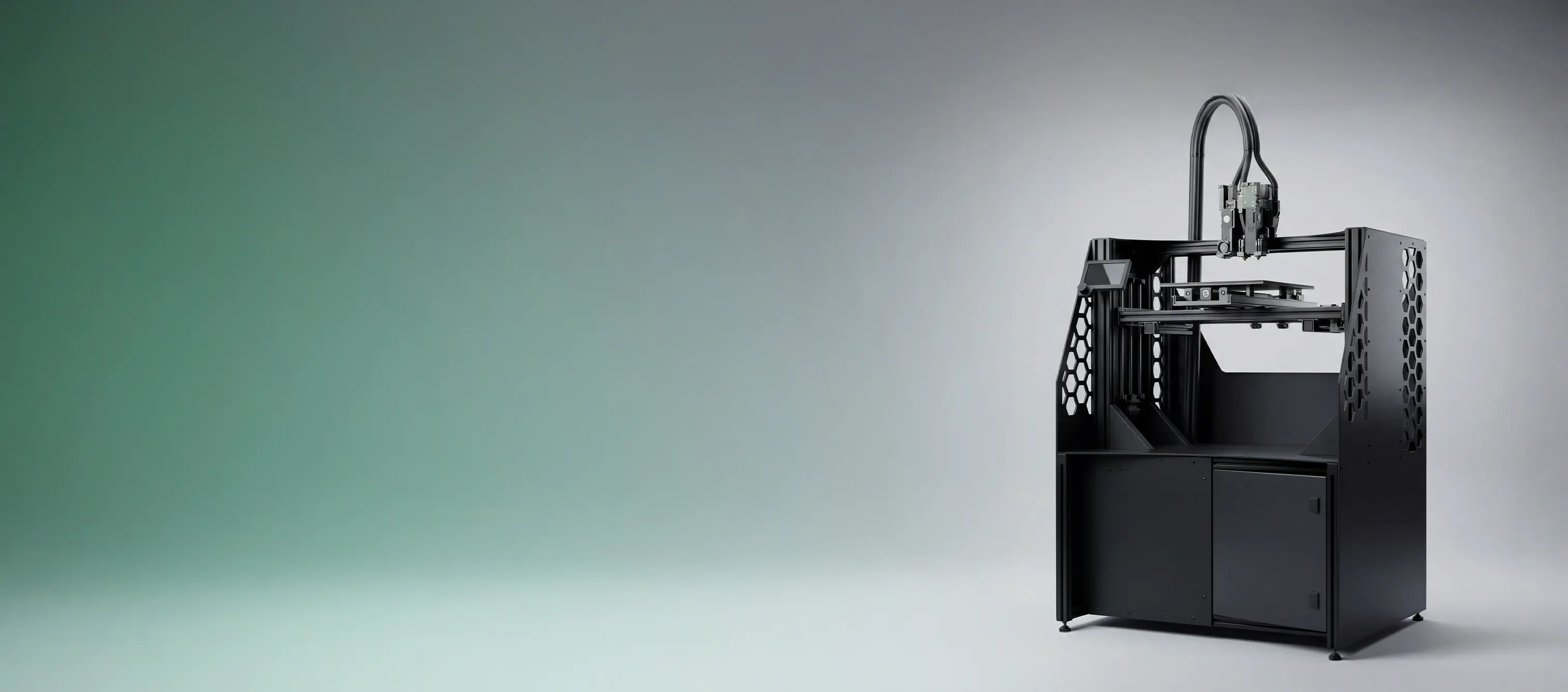
Industrial additive manufacturing

S2S Systems 3D printing system

Our systems

Our 3D printers and systems are designed for industrial additive manufacturing with pellet and filament materials.

Material variety & efficiency

The focus is on processing polymer-bound compounds, bespoke material blends and – where needed – conventional filaments. A key advantage of our systems is that they can process customer-supplied pellets directly. This allows materials from the injection moulding industry, in-house developments or recycled materials to be used directly. That lowers material costs, increases throughput rates and considerably widens the range of possible materials.

Features shared by all systems

  • Pellet- and/or filament-based manufacturing
  • Processing of compounds, material blends and customer pellets
  • High throughput rates at lower material costs
  • Robust mechanical design and precise linear guidance
  • Standard parts for ready availability of spare parts
  • Intelligent control and software architecture
  • Freely scalable build volume
  • Industrial-grade reliability and durability

Optional equipment & configuration

All systems are freely configurable. Build volume, extruders, nozzles, the number of print heads (MultiPrint) and optional equipment can all be tailored to your application. Our 3D printers are not off-the-shelf machines but application-specific production systems.

Enclosure
Slicer software
Service and maintenance packages
IT security concepts
Bespoke extruder configuration
Pneumatic conveying
KeraPrint

KeraPrint

Specialised 3D printer for polymer-bound compounds

The KeraPrint is a specialised 3D printer for polymer-bound compounds with a pellet extruder.

  • Processing of polymer-bound ceramics
  • Material-specific process parameters and slicer profiles
  • Fully hardened extrusion screw and extruder body
  • Hardened nozzles in various diameters
  • Suited to parts with fine detail and to high throughput
MultiPrint

MultiPrint

Multi-material printing with several pellet extruders

The MultiPrint is a specialised pellet 3D printer with several extruders, offering maximum flexibility through multi-material printing.

  • Several pellet extruders in one system
  • Variable number of print heads
  • Processing of different materials in a single print job
  • Different nozzle diameters and throughput rates can be combined
  • Additives can be blended in during printing
UniversalPrint

UniversalPrint

Versatile entry-level printer for plastics

The UniversalPrint is the versatile entry-level printer for plastics, with a flexible extruder system that handles both filament and pellets.

  • Pellet extruder for engineering plastics
  • Robust, industrial construction
  • Reliable and reproducible processes
  • Ideal for functional prototypes, fixtures and small series

Build volume, output and what goes into the machines

Three series, one kit

Our machines are built from the same frame and the same control system. What differs is build volume, extruder and equipment. All three work on Cartesian kinematics with the print bed moving in X, Y and Z.

MachineBuild volume fromBuild volume toExtruderStrength
KeraPrint200 × 200 × 200 mm800 × 800 × 800 mmpelletsabrasive ceramic compounds
MultiPrint300 × 300 × 300 mm800 × 800 × 800 mmseveral extrudersmulti-material, additives blended in live
UniversalPrint200 × 200 × 200 mm800 × 800 × 800 mmpellets or filamentplastics from either material form

The output rate is up to 500 grams per hour with plastics and up to 200 grams per hour with ceramics. A filament extruder manages only a fraction of that – which is why large parts only pay off with pellets at all.

The configurator shows which machine suits your application: enter the build volume, choose the options, see an indicative price.

Industrial standard, not a workshop build

Our machines contain components that are at home in industry: power supplies from Meanwell, switchgear from Finder, control cabinets from Rittal and aluminium profiles from European production. That is not about brand names but about spare-parts availability: you will still be able to get these parts in ten years, and not only from us.

All required tests are carried out before delivery. As a customer you receive the documentation for them.

Delivery, commissioning, service

  • Lead time: 8 to 12 weeks from order. We settle connectivity, floor space and connection requirements with you beforehand in any case.
  • Commissioning: we come to you, one day on site.
  • Warranty: 12 months, wear parts excluded.
  • Service: maintenance contracts are available; we usually find a solution within a few working days.
  • Training: we cover operation and process parameters in a training session on your machine.

The control system is based on Klipper and is open: you connect your own sensors and adjust sequences yourself instead of waiting for a firmware update. There is more on this under 3D printer software built to measure.

Test first, then invest

A machine is an investment that has to be justified internally. The lower-risk route runs through our 3D printing contract manufacturing: have your part produced by us first. Then you know whether the material and the process hold up before you decide on hardware of your own.

Jonas Siegrist, Managing Director and Head of Development
Your contact

Jonas Siegrist

Managing Director and Head of Development

Before you decide on a machine, talk to me about your part and your material. I reply within 24 hours; a works visit in Jena or a live print over a video call is possible at any time.