MultiPrint

MultiPrint

Multi-material printing with several pellet extruders

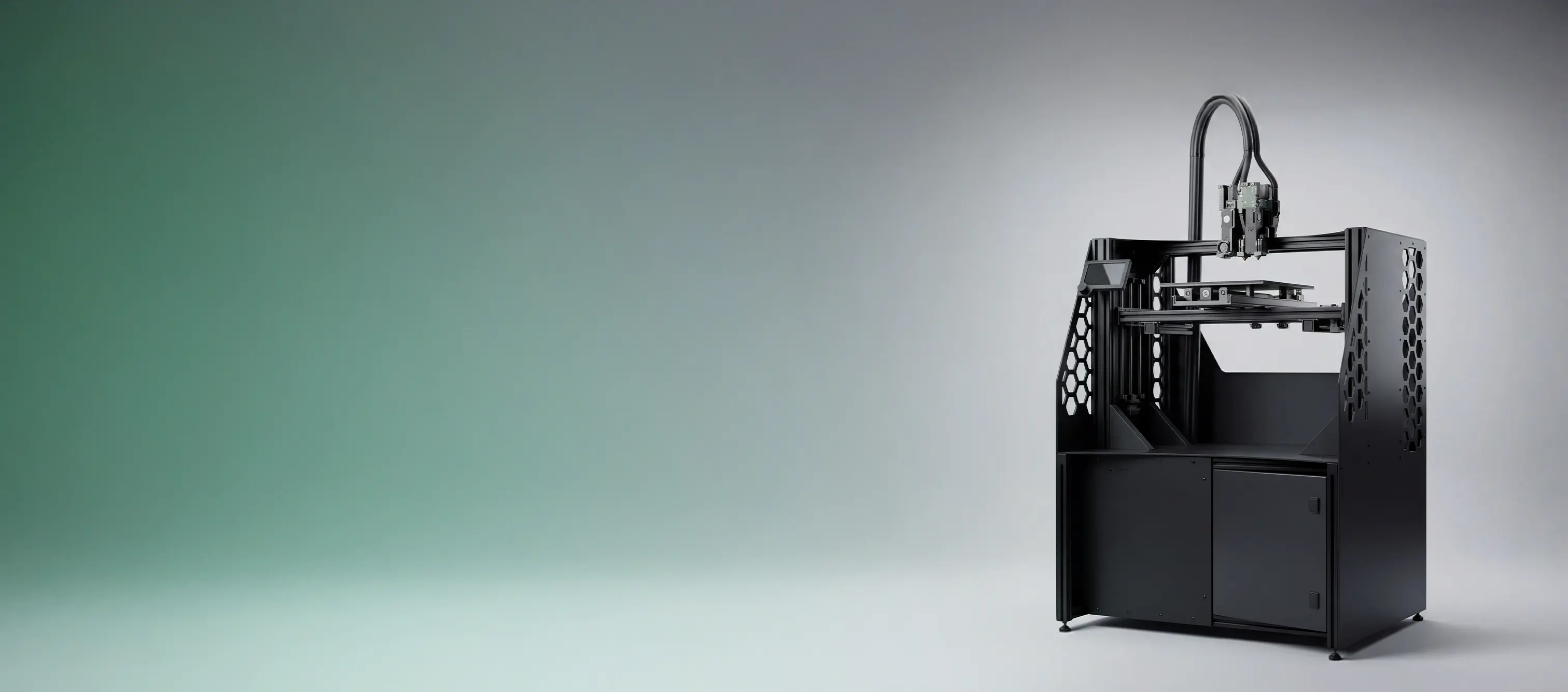
The MultiPrint is a specialised pellet 3D printer with several extruders, offering maximum flexibility through multi-material printing.

Multi-materialSeveral extrudersPneumatic pellet conveyingReputable standard parts
MultiPrint

Advantages of the MultiPrint

Feature
Several pellet extruders in one system
Variable number of print heads
Processing of different materials in a single print job
Different nozzle diameters and throughput rates can be combined
Additives can be blended in during printing

The MultiPrint is a specialised pellet 3D printer with several extruders, offering maximum flexibility through multi-material printing.

01

Multiple pellet extruders for plastic pellets and bulk material up to 5 mm

02

Combination of different materials, bead diameters and material blends

03

Technical honesty, innovation and maximum reliability

04

Adaptable to individual requirements and build volumes

01

Construction

Frame

Load-bearing structure made of 40×40 mm and 40×80 mm black anodised aluminium profiles
Joints made from 3 mm laser-cut and powder-coated aluminium sheets
Maximum torsional stiffness and exceptional accessibility
Ample room for storage areas and optional pneumatic pellet conveying
Optional enclosed build chamber

Guide elements

High-quality, generously dimensioned linear guides for the X, Y and dual Z axes
Adjustable play on the carriages

XY carriage

Cartesian kinematics
Milled cast aluminium parts for maximum flatness and stiffness
Ball screw with a 10 mm pitch for high print speeds and minimal backlash
02

Extruder system

Multiple pellet extruders

Several pellet extruders for bulk material and pellets
Number of extruders freely selectable
Cooled feed zone

Material feed

Feed via hopper for manual filling
Optional: pneumatic conveying

Drive & cooling

NEMA 17 stepper motor with gearbox per extruder for maximum torque
2 powerful part coolers with optimised airflow routing

Functions

Retraction possible despite pellet extrusion
High heating capacity for high mass throughput
Different materials within a single part
Different bead diameters within a single part
Material blends within a single part
03

Print bed

Construction

8 mm precision-milled cast aluminium print bed
High flatness even at high bed temperatures

Build platform

Spring steel print plate with textured PEI coating
Quick changeover, optimal adhesion for many print materials
High-temperature magnetic sheet with strong magnetic force at high temperatures

Heating

Silicone heating mats for fast warm-up
Additional temperature monitoring at several points
Several heating zones with intelligent control for energy-efficient printing
04

Electronics

Components

Reputable components from Meanwell, PILZ and Siemens
Compliant and safe machine logic
32-bit BigTreeTech mainboard for fast data and signal transmission
Raspberry Pi 5 with 8 GB RAM: fast processing of print data, precise axis control
TMC 5160T Pro motor drivers for the X, Y, extruder and both Z drives

Motors

NEMA 23 stepper motors for the X and Y axes: high force transmission, high resolution
Powerful NEMA 23 motors for both Z drives
48 V power supply for high forces at low currents

Sensors

Mechanical proximity switches for the X and Y axes (reliable output values)
Inductive sensor on the print head for the Z axis, bed levelling and tilt adjustment
05

Operation

Display

Capacitive touch display
User interface (UI), optional on-board slicer
All printer parameters adjustable via the web interface

Technical data

Build volume
Standard: 400×400×300 mm (X×Y×Z) · Other dimensions available
Enclosure
Optionally enclosed
Print bed
8 mm precision-milled cast aluminium plate · Magnetic system included · Textured PEI spring steel plate
Extruder systems
Software
Firmware: Klipper with extensions for safety and automation · Raspberry Pi 5 with 8 GB RAM · MCU by BigTreeTech · Large capacitive touch display
Electrical spec.
System voltages: 230 V AC, 48 V DC, 24 V DC, 5 V DC
Guide system
Linear guides
Material compatibility
Plastics · plastic blends · batches

Highlights

Several extruders enable multi-material printing

Combination of different materials within a single part

Different bead diameters can be freely combined

Material blends created during printing

Larger standard build volume (400×400×300 mm)

Robust construction with 40×40 mm and 40×80 mm profiles

Stronger NEMA 23 motors and 48 V system voltage

Designed specifically for complex multi-material applications

Applications

01

Multi-material parts

02

Gradient structures

03

Functional material transitions

04

Experimental material blends

05

Batch production with different materials

S2S-Systemdrucker GmbH

Interested in the MultiPrint?

Configure your system individually or get in touch with us.