
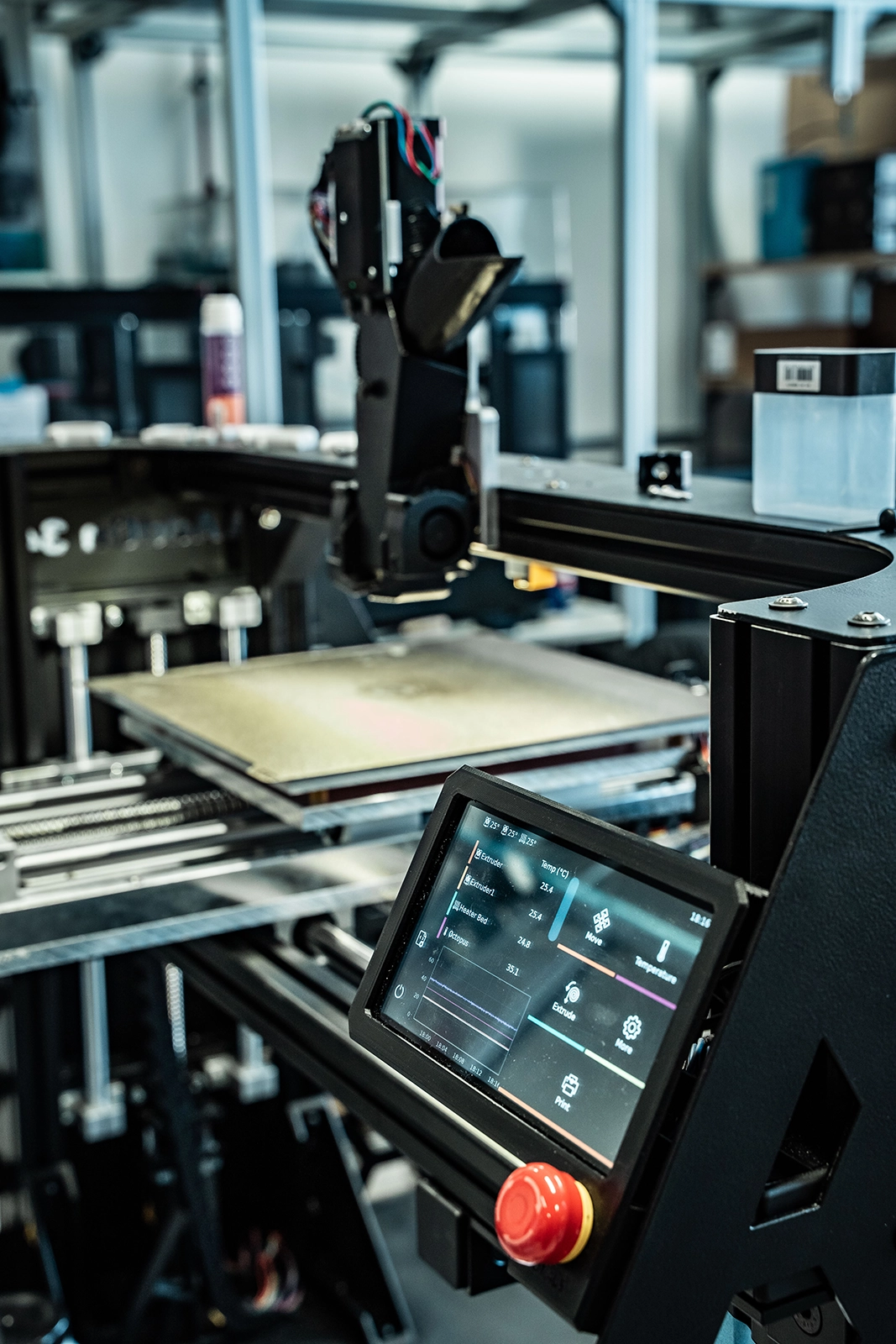
The definition of additive manufacturing in the standards
Under the international standards DIN EN ISO/ASTM 52900, additive manufacturing is a primary shaping process. The term covers all additive manufacturing processes in which parts are built up layer by layer from digital data. Unlike subtractive manufacturing, where material is removed, additive manufacturing produces parts by adding material in a controlled way.
Additive manufacturing (AM) is the internationally common designation and describes the same technology. Within industry the term additive manufacturing has become established, particularly in technical contexts and in normative guidelines.
This definition forms the basis for understanding all additive production processes.
The difference from subtractive manufacturing
The central difference between additive manufacturing and conventional manufacturing processes lies in the material flow. Whereas in machining processes tools remove material, additive manufacturing builds material up layer by layer.
That means:
No material removal by milling or turning
No conventional tooling costs
Digital production directly from 3D data
Great design freedom with complex geometries
For complex parts with internal structures or cavities in particular, additive manufacturing offers enormous possibilities.
The digital basis: from 3D data to a layer
Every additive manufacturing process begins with digital data. 3D models are designed and then split into individual layers. This layer information controls the 3D printers while they print.
The resolution of the individual layer largely determines:
Surface quality
Level of detail
Mechanical properties
Production time
The finer the layer, the higher the precision – though production time increases accordingly.
Materials in additive manufacturing
Additive manufacturing makes it possible to process a wide variety of materials. Plastic is especially widespread. Thermoplastics such as PA, ABS or PETG dominate in 3D printing. Thermosets are used above all in curing-based processes.
Alongside plastic, the following materials are processed:
Metal powders (for example in laser beam melting)
Ceramic materials
Composite materials
Tissue structures for medical applications
The choice of material directly influences use, application cases and production processes.
An overview of additive manufacturing processes
Additive manufacturing processes can be divided into various categories under the standards. The most important processes in industry are:
Stereolithography
Digital light processing
Selective laser sintering
Laser beam melting
Binder jetting
FDM / FFF
FGF
Binder jet deposition
Material jet deposition
These additive 3D printing technologies differ in material, process, industrial application and cost-effectiveness.
Stereolithography (SLA)
Stereolithography is one of the oldest additive manufacturing processes. A laser beam cures liquid plastic layer by layer. Production takes place in a resin vat.
Advantages:
Very fine layer resolution
High dimensional accuracy
Good surface quality
Disadvantages:
Limited range of materials
Low UV resistance
This process is often used for prototypes and models.
Digital light processing (DLP)
DLP is technically related to SLA. Instead of a laser beam, an entire layer is exposed via a display.
Used for:
Rapid prototyping
Research
Design studies
Selective laser sintering (SLS)
In SLS, plastic powder is fused layer by layer by a laser beam. The surrounding powder supports the parts during production.
Typical applications:
Functional prototypes
Series production in small quantities
Technical product development
Laser beam melting (metal AM)
In laser beam melting, metal powder is fully melted by a laser. This additive manufacturing process is used in aerospace and in construction.
It produces high-strength workpieces with complex structures.
Binder jetting and binder jet deposition
Binder jetting is one of the powder-based additive manufacturing processes. A print head applies binder selectively to a powder bed.
This process – also referred to as binder jet deposition – is particularly suited to:
Colour models
Foundry patterns
Architectural applications
Binder jetting allows high build speeds but lower mechanical strength without post-processing.
Large scale additive manufacturing (LSAM)
LSAM is the scaled-up form of FGF technology, using large-volume 3D printers or robotic systems.
Fields of use:
Construction
Tooling
Mould making
Industrial plant
This form of additive manufacturing makes it possible to produce objects metres high and complex shapes from plastic.
FDM / FFF – filament-based 3D printing
FDM is one of the best-known 3D printing processes. Plastic filaments are melted in 3D printers and deposited layer by layer.
Characteristics:
High flexibility
Low tooling costs
A broad choice of materials
This additive process is used in rapid prototyping, in development and increasingly in series production.
FGF – pellet-based additive manufacturing
FGF works directly with plastic pellets, which removes the intermediate steps of material preparation.
Advantages:
Cheaper materials
Direct use of industrial materials
Higher production speed
This production process is becoming increasingly important in industry.
Rapid prototyping and series production
Additive manufacturing was originally used in rapid prototyping. Today its range extends all the way to series production.
Advantages:
Fast development
Reduced production costs in small quantities
Great design freedom
For companies with bespoke products in particular, AM increases competitiveness.
Materials and geometries
A decisive advantage of additive manufacturing lies in producing complex geometries. Internal channels, lattice structures or organic shapes can be realised without additional tooling.
For example:
Cooling channels in workpieces
Lightweight structures
Air ducting
These possibilities can only be achieved to a limited extent with conventional manufacturing processes.
Standards, guidelines and industrial requirements
Standards and guidelines are essential to additive manufacturing. They define:
Terminology
Quality requirements
Process parameters
Material classes
Complying with these standards matters particularly in industry and in the medical field.
Relevance for industry and business
Additive manufacturing is changing conventional production processes. It allows:
Decentralised production
On-demand manufacturing
Bespoke products
Reduced stockholding
For companies that means new concepts in development, production and logistics.
The process chain in additive manufacturing
A typical process comprises:
Designing the 3D models
Preparing the data
Slicing into individual layers
Printing
Post-processing
Know-how in handling these processes determines quality and cost-effectiveness.
Research, development and future potential
Additive manufacturing is strongly research-driven. New materials, improved curing processes and optimised production processes continually broaden the range of applications.
The potential lies in particular in:
Individualised products
Lightweight construction
Functional integration
Hybrid manufacturing
Conclusion: additive manufacturing as a key technology
Additive manufacturing is more than just 3D printing. It is a technology in its own right with a clear definition, a normative basis and growing industrial relevance.
From rapid prototyping to series production it opens up new possibilities for companies in producing complex parts. Additive manufacturing processes allow a flexibility that is hard to achieve with conventional production processes.
For engineers, developers and decision-makers in industry, understanding additive manufacturing is no longer optional – it is a strategic foundation of future competitiveness.