
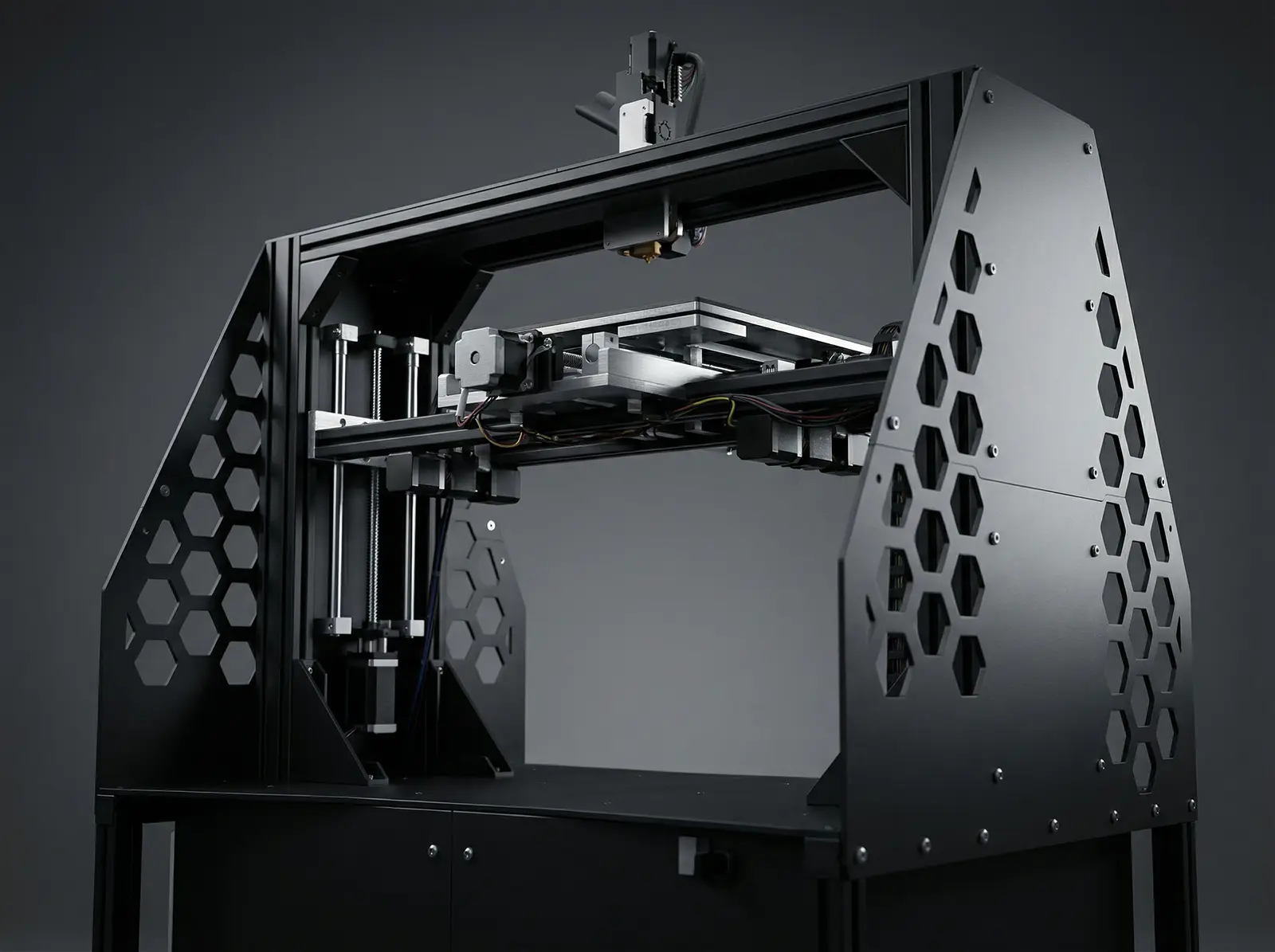
Additive manufacturing has made enormous progress in recent years, but hardly any area is growing as dynamically or offers as much potential as ceramic 3D printing. For engineers, technical managers and scientists, the combination of geometric freedom and the outstanding properties of technical ceramics opens up entirely new possibilities. At S2S-Systemdrucker GmbH we understand exactly what industry needs. In this article we look at the technology behind the modern ceramic printer, the challenges of processing abrasive materials and what separates professional systems from entry-level solutions on the market.
The basics: what makes ceramics different in 3D printing
First of all we need to understand what the material means in the process. Unlike metals, ceramics in 3D printing are almost always processed in a polymer-bound form. The raw material is never pure powder on its own but a mixture, whether as a resin, a filament or pellets. In photopolymerisation (SLA, DLP, LCM) the ceramic is cured in resin form by UV light. These processes undeniably offer very high part quality and fidelity of detail.
At S2S Systems, however, we concentrate on a technology that is often more robust and more scalable in the industrial value chain: FFF (fused filament fabrication) and FGF (fused granulate fabrication). Here, ceramic 3D printers differ hardly at all in their kinematics from conventional 3D printers for plastics. But appearances deceive, because the range of demands placed on the components and applications of the printer is extremely high.
Demands on the extruder and the printer hardware
The decisive difference lies in the material. The filaments and pellets contain a very high loading of inorganic ceramic powder, often up to 80 %. Whether aluminium oxide, zirconium oxide, silicon carbide or porcelain – these materials are known for their extreme hardness. For the machine that means the material acts like sandpaper as it is conveyed.
Conventional brass or steel nozzles would fail within a few printing hours. The development of our machines therefore focuses on maximum wear resistance. On the filament extruder, the gearbox and the nozzle of the printer in particular, hardened parts have to be used. This is even more critical in pellet printing. Here the entire extrusion screw, the extrusion body (barrel) and the nozzle of the printer have to be specially hardened. Only then can the abrasion be handled without the precision of the printer suffering or metal debris contaminating the ceramic parts.
Thermal management and process control
A ceramic 3D printer has to be controlled thermodynamically differently from a pure plastics printer. Because of the waxes and plasticisers in the binder, the material behaves more like a paste and has a considerably lower softening point. Processing often takes place at around 150 degrees Celsius, whereas engineering plastics frequently need well over 200 degrees.
The challenge for the printer's control lies in heat retention. Ceramics store heat far longer than plastic. Particular attention is needed in the machine's extruder. That means:
The print speed has to be matched precisely to the cooling capacity.
The layer height must be neither too great nor too small.
Intensive cooling is necessary so that the part keeps its shape.
At the same time the layer must not cool too much, so that the next one bonds reliably.
It is a technical balancing act that we solve through specific print profiles for our customers. The machine has to master this compromise between extrusion speed and temperature perfectly.
Infill density and trapped air
One specific feature of ceramic 3D printing is the infill. In plastics printing we often save weight and material through lattice structures. With ceramics it is different. To obtain a dense sintered structure, a 100 % infill is almost always required. The printer's control has to guarantee that no air is trapped. Air bubbles would expand in the sintering furnace or lead to cracks, destroying the mechanical performance of the part.
Material efficiency and recycling: pellets vs filament
A major advantage of our pellet systems (FGF) is sustainability. Technical ceramic materials are expensive. With a pellet printer there is a decisive economic advantage: if a print fails, the “green part” (the unsintered component) can simply be shredded and returned to the process. With filament printing that is only possible to a very limited extent, since the material would first have to be extruded back into filament at considerable effort.
Ceramic filaments also often have problems with shelf life. The polymer binder absorbs moisture. Drying is often impossible because of the low melting temperature, without the filament sticking together on the spool. Storing the materials and maintaining the printer therefore require experience. Our specialists are happy to advise you on this.
Fields of application and parts
The applications are varied. We see parts in:
Industry: wear-resistant nozzles, bearings and seals.
Medical technology: biocompatible implants (often from oxide ceramics).
Research: development of new materials and geometries.
Energy: heat shields and insulators.
The S2S promise: more than just a machine
We do not only sell products, we deliver solutions. A purchase from S2S means a partnership. We know that the specification on the datasheet is not everything. We create specific print profiles for your requirements. Our aim is an experience close to “plug and play”, even with materials as complex as these. In the end the quality of the printer determines the quality of your end product.
Our software provides precise machine guidance, which is indispensable for near-net-shape production. Our focus is always on functional parts. Appearance matters, but the technical integrity of the structures comes first.
The build volume of our machines is scalable too, so that everything from a small format through to large industrial plant is possible.
Conclusion: the future is ceramic
The market for ceramic 3D printers is growing rapidly. The combination of the design freedom of 3D printing and the hardness of ceramics solves many industrial problems. Whether you are coming from an entry-level machine or want to move straight into high-end production – S2S is your partner. The importance of this technology will continue to grow in the years ahead.
Are you interested in a test print, or do you need further information? Put your preferred configuration in the basket for a non-binding enquiry, or contact us directly.
A summary of the advantages of the S2S printer
Processing of high-performance ceramics.
Hardened components throughout the extrusion path.
Configurable build volume and machine size (print bed size to order).
Software adapted to complex model geometries.
The option to reuse pellets (cost savings).
Professional support from our team.
From simple object printing in prototyping to complex series production – with an S2S ceramic 3D printer you are equipped for the future. Choose industrial reliability. The capabilities of our machines will convince you. For further information get in touch with us or share your experiences.
Author: Jonas Siegrist
Company: S2S-Systemdrucker GmbH