
Ceramics are among humanity's oldest materials – and at the same time one of the most modern. In industry and research, “technical ceramics” stand for extreme durability, heat resistance and chemical inertness. But as outstanding as those properties are, producing complex geometries has until now been just as challenging. This is where 3D printing of ceramics creates new paradigms.
For engineers, technical managers and scientists, additive manufacturing of ceramic parts opens up dimensions that would be barely achievable with conventional methods, or only at enormous cost. At S2S-Systemdrucker GmbH we devote ourselves to exactly this interface: we bring together the precision of 3D printing with the uncompromising quality of high-performance ceramics.
The paradox of ceramics: tough to take, hard to give
Ceramics are a material of extremes. Anyone thinking about technical applications in aerospace, medical technology or mechanical engineering can hardly avoid ceramic materials. They offer temperature resistance far beyond that of metals or polymers. Their chemical resistance makes them immune to acids and alkalis.
But for a long time those very advantages were also the greatest curse in manufacturing. Their enormous hardness and brittleness make machining extremely difficult. Conventional processes mostly rely on pressing powder into a shape and then firing it. The resulting blank then often has to be reworked subtractively at considerable effort – by grinding with diamond tools, for instance.
That does not only create high tooling costs. The forces and vibrations introduced during machining often lead to micro-cracks or even to the part breaking. The more complex the geometries, the less economical conventional production becomes. Undercuts or internal channels? Often impossible with milling or turning.
The game changer: 3D printing with ceramics
3D printing makes it possible to compensate for this fundamental machining drawback. Additive manufacturing allows the positive properties of ceramics to be combined with the geometric freedom of printing. Instead of laboriously removing material, it is built up only where it is functionally needed.
The key to success lies in separating shaping from material consolidation. Using polymer-bound ceramics, parts can be produced that initially exploit all the advantages of 3D printing. Downstream thermal processes then transform this “green part” into a fully dense ceramic component that, in terms of strength and density, is barely inferior as a product to conventionally manufactured parts.
How does the process work in detail?
In principle most industrially relevant processes are multi-stage. The ceramic is not melted directly here (which would be barely feasible energetically given the extreme melting points) but shaped with the help of a carrier.
Shaping (printing): ceramic particles or powder are held in shape by an organic plastic binder. That binder effectively acts as a skeleton. The mixing ratio is typically around 80 % inorganic ceramic and 20 % organic constituents (plastics, plasticisers, waxes).
Debinding: most of the plastic binder is removed by chemical solvents or thermal processes. This creates pore channels through which residual gases can escape in the next step.
Sintering: this is the most critical step. At temperatures well above 1000 °C the remaining plastic is burned off and the ceramic particles bond into a dense structure (sintering). The part shrinks in a controlled way but reaches its final hardness and density.
Technologies compared: SLA/DLP/LCM vs FFF/FGF
Anyone looking into 3D printing solutions for ceramics comes across various process names such as LCM (lithography-based ceramic manufacturing), digital light processing or stereolithography.
Particularly well established are processes in which ceramics are processed in liquid form as a resin (SLA or DLP). Here a photosensitive resin filled with ceramic powder is cured by UV light. Research institutes and manufacturers in this segment have advanced the technology considerably.
But this method has drawbacks too: wall thicknesses are often limited, and handling the liquid, highly viscous resins is demanding in an industrial environment. The choice of materials is also restricted to photopolymerisable systems.
The S2S-Systemdrucker GmbH approach: filament and pellets
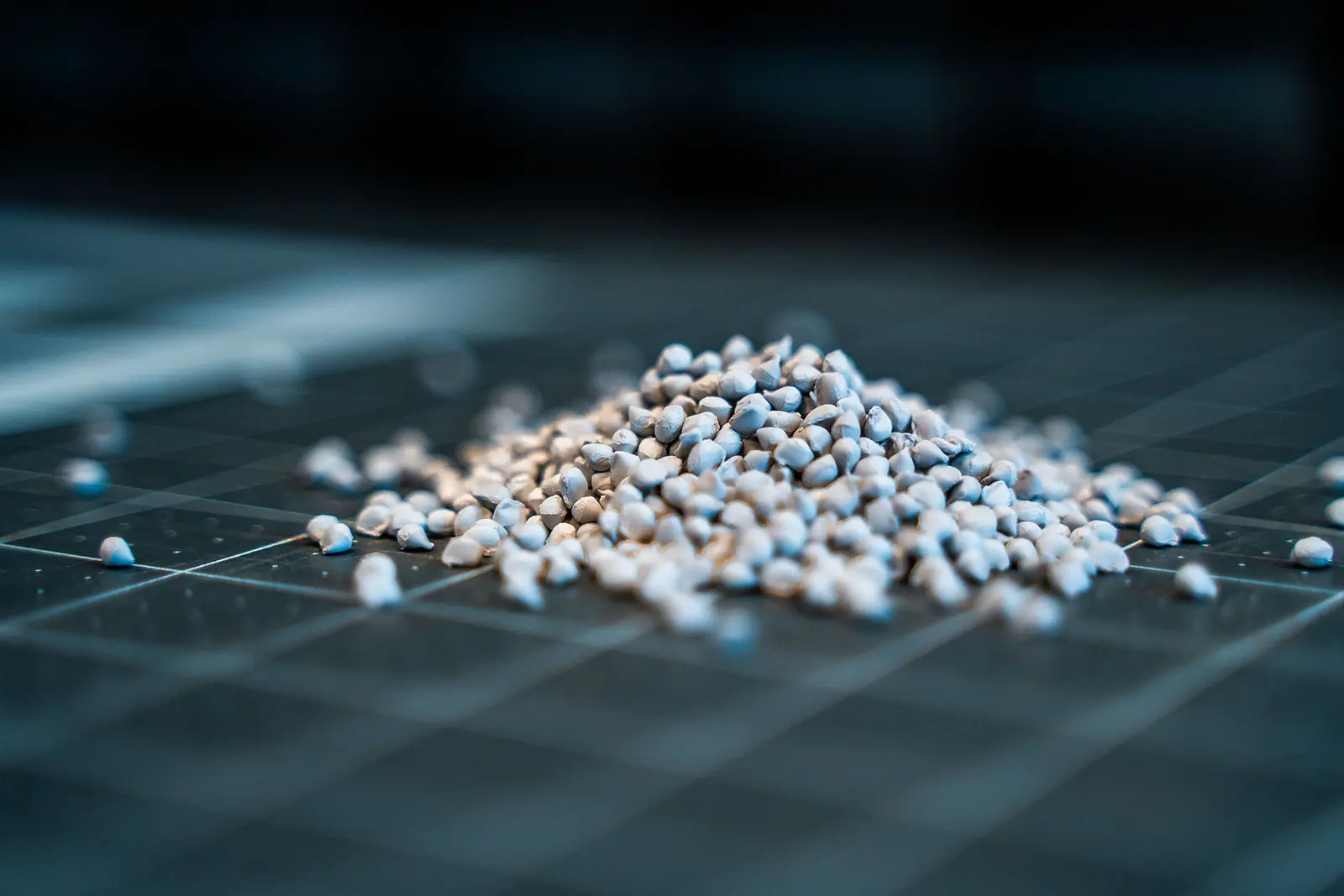
For us at S2S-Systemdrucker GmbH, and for many industrial applications, the FFF (fused filament fabrication) and FGF (fused granular fabrication) processes are of greater interest. Here we process ceramics bound in a thermoplastic – either as a filament spool or directly as low-cost pellets.
As in conventional plastics 3D printing, the material is heated in an extruder and deposited layer by layer through a nozzle. That brings decisive advantages for production:
Material variety: we can draw on standard injection moulding pellets (feedstocks) that are already qualified in industry.
Dense parts: thanks to the high loading in the filament or pellets we achieve densities of over 99 % after sintering.
Cost-effectiveness: machine costs and material prices are often more attractive than with highly specialised laser systems, particularly at medium quantities.
Materials: more than just pottery
When we speak of ceramics in an engineering context, we mean high-performance ceramics (technical ceramics). The range of materials that can be processed in 3D printing is impressive and covers almost every requirement of modern industry.
Oxide ceramics
First and foremost are aluminium oxide (Al2O3) and zirconium oxide (ZrO2). Al2O3 stands out for its excellent electrical insulation and strength. It is the standard for insulators, seal rings or substrates in electronics.
ZrO2, by contrast, is often called “ceramic steel”. It has high fracture toughness and impact strength, making it considerably less brittle. It also has very low thermal conductivity and high wear resistance, which makes it particularly suitable for dynamically loaded and safety-critical applications.
Non-oxide ceramics
These include silicon carbide (SiC) and variants such as SiSiC. These materials are extremely hard, thermally conductive and resistant to thermal shock. They are used in plain bearings, seals and combustion chambers.
Beyond that we are able to process materials such as porcelain for design applications, combinations with diamond content for tooling, or soft ferrites for electrical engineering. That range allows us to respond flexibly to customer requirements.
Applications and sectors
The range of possible uses for printed ceramics is as broad as the sectors that ask for them. Wherever metal reaches its limits – whether through corrosion, wear or electrical conductivity – ceramics come into play.
Medical technology
In medicine biocompatibility is decisive. Ceramics trigger no allergies and do not wear. Patient-specific implants or surgical instruments can be printed directly from CAD data taken from a scan. Small series or prototypes for clinical studies can be produced within a few days.
Mechanical engineering and aerospace
Pump components, nozzles or valves exposed to aggressive media benefit from the enormous resistance of technical ceramics. 3D printing allows flow channels in the components to be optimised (bionic structures, for instance) in order to increase the efficiency of the equipment.
Electronics and electrical engineering
Thanks to its high dielectric strength, ceramic is the ideal insulator. 3D-printed heat sinks of aluminium oxide can dissipate heat without being electrically conductive – a decisive property compared with metal heat sinks in power electronics.
The advantages of additive ceramic manufacturing at S2S Systems
Why should you choose 3D printing services or 3D printers from S2S? The advantages over conventional manufacturing are measurable:
Design freedom: undercuts, cavities and complex free-form surfaces are achievable.
Less post-processing: parts are printed near net shape. Core holes for threads, fitting holes or fine channels are already included in the print. That saves expensive grinding processes.
Speed: it often takes only days from idea to finished part, instead of months for mould making.
Cost at small quantities: for prototypes and small-series production, tooling costs disappear entirely.
There are challenges, of course. Shrinkage during sintering has to be calculated precisely in the design (CAD). This is where we bring our expertise to bear, to make sure the precision is right in the end.
S2S-Systemdrucker GmbH: your partner and full-liner
The market for technical ceramics is complex. But when it comes to bespoke solutions, agile development and additive manufacturing, specialist partners are needed.
S2S-Systemdrucker GmbH sees itself not just as a service provider but as a technology partner. We work closely with material manufacturers so that we can always offer the latest filaments and pellets. Our network also covers the necessary post-processing steps – from debinding in special furnaces through to high-temperature sintering.
Our long-term goal is clearly defined: we want to develop into a full-liner covering the entire value chain, from consulting through design to delivery of the sintered final part. This development helps companies to improve their products by using high-performance ceramics.
Conclusion: the future is ceramic
Ceramic 3D printing is long past being a niche for pure research projects. It is a valid manufacturing technology that solves problems where other processes fail. Whether it is heat protection in aerospace, wear protection in mechanical engineering or innovations in medical technology – the combination of digital manufacturing and an ancient material is more powerful than ever.
Do you have parts that wear out regularly? Or geometries you have had to simplify for production reasons? Let's talk about your requirements. Send us your questions or initial CAD data with no obligation.
Downloads & contact
Visit our download area for technical datasheets on Al2O3, ZrO2 and other materials, or contact us directly for personal advice.