
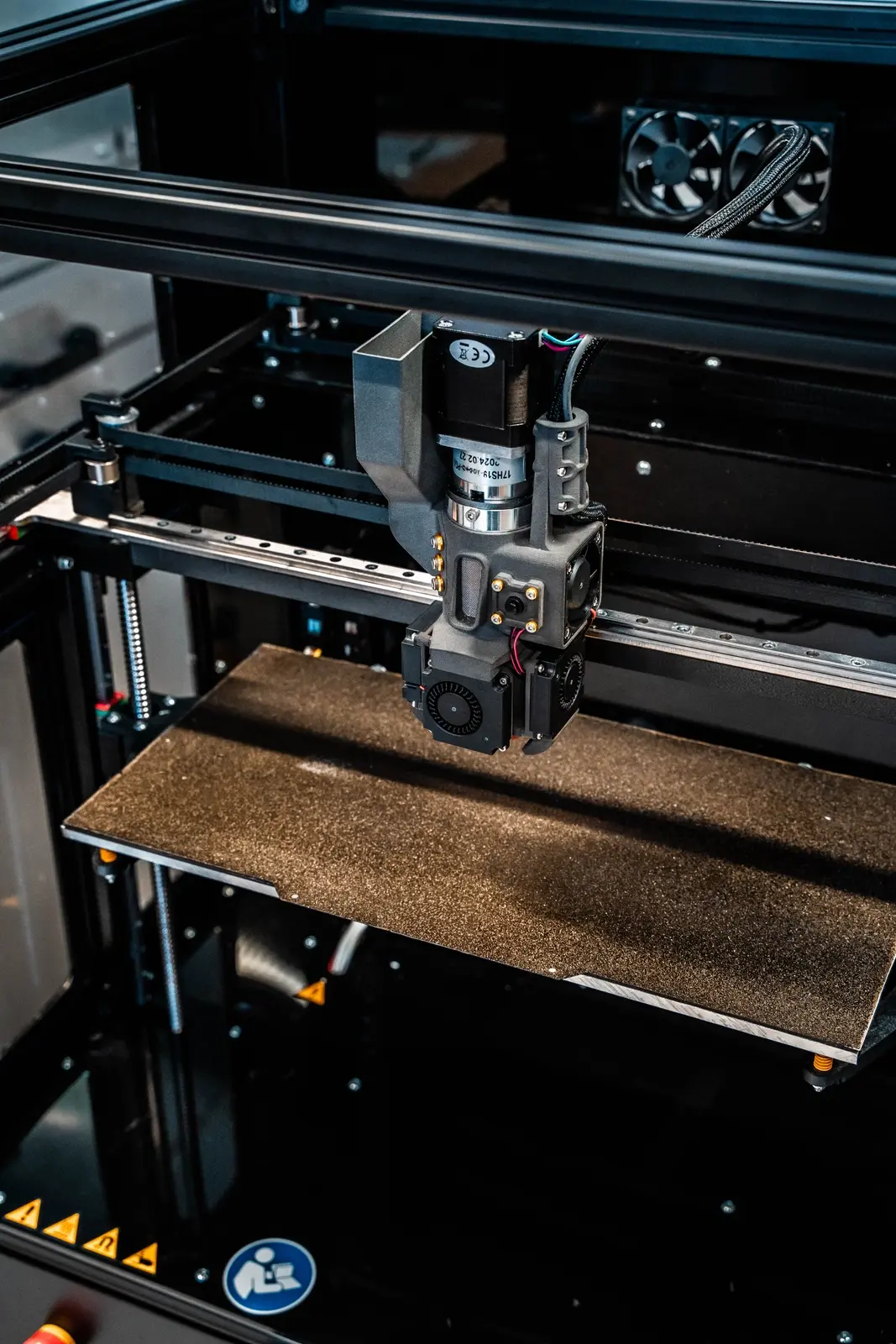
Anyone working with additive manufacturing in an industrial setting comes up against a fundamental comparison sooner or later: filament extruder or pellet extruder? Both approaches are representative of two established 3D printing processes – FFF (fused filament fabrication) and FGF (fused granule fabrication). In this article, Jonas Siegrist of S2S-Systemdrucker GmbH analyses the technical differences, the common ground and the respective fields of application – practically and in depth, for decision-makers, engineers, technical managers and scientists.
From S. Scott Crump to the RepRap project: the roots of FFF technology
To understand the relevance of fused filament fabrication today, it is worth a look back. The process known today by the abbreviation FFF was originally developed by S. Scott Crump at the end of the 1980s and commercialised by the company Stratasys. Stratasys patented the process under the name FDM – fused deposition modeling. That term remains widespread in the market to this day, even though strictly speaking it is an acronym protected by Stratasys.
When the FDM patent expired, the market opened up to a host of manufacturers. The RepRap project in particular drove the democratisation of 3D printing: under the name RepRap an open-source concept for a self-replicating 3D printer emerged, inspiring countless projects and machines. The term fused filament fabrication (FFF) established itself as a neutral, unprotected designation for exactly the same process – preferred today by companies that do not wish to license from Stratasys.
In the context of standardisation the process is also listed as MEX – material extrusion. MEX is the ISO/ASTM-compliant umbrella term for all extrusion-based 3D printing processes, which includes both FFF and FGF. Anyone speaking about 3D printing technology in a normative sense increasingly uses the term MEX.
What fundamentally links the two 3D printing processes
Both the filament-based and the pellet-based 3D printer rest on the same core principle: thermoplastic material is plasticised and extruded through a nozzle of smaller diameter. The emerging plastic bead is deposited layer by layer on the print bed until the finished part has taken shape.
Both processes work with polymers that are melted and processed in a defined state. Both also share the fact that the quality of the result depends largely on process control – on temperature management, feed rate, nozzle diameter and the precision of the motion axes. The differences begin where the material first comes into contact with the system: at the material feed.
The filament extruder and the FFF process: mechanically defined and precisely controllable
The filament extruder works with a pre-made plastic wire – the filament. This is unwound from a spool, fed into the hot end by a feed gear (also called an extruder or feeder) and melted there. The print head positions the melt precisely over the print bed.
As long as the filament has a consistent diameter, the gear conveys a precisely defined quantity of material per revolution. This mechanical predictability is one of the greatest advantages of FFF (fused filament fabrication): the process is readily calculable, reproducible and can be run stably with a manageable amount of calibration.
Filament diameter and spool availability
Two filament diameters have established themselves on the market: 1.75 mm and 2.85 mm. The original thinking was that 2.85 mm would allow higher throughput, since more mass is conveyed per millimetre of wire feed. In practice, though, the 1.75 mm standard has prevailed more strongly – spools are more widely available, the choice of materials is greater and support from 3D printer manufacturers is more comprehensive.
A typical FFF 3D printer achieves material throughputs of around 200 to 300 grams per hour. That figure depends on material, temperature and nozzle diameter. For many applications in prototype development, tooling and small-series production, it is entirely sufficient.
Support structures, support material and part geometry
With complex geometries the FFF 3D printer needs support structures. These supports are printed either from the same print material or from a separate support material that is easier to remove after printing – by dissolving in water or by mechanical removal, for instance. For technical managers and designers this is a relevant planning consideration, since removing supports costs time and resources.
The pellet extruder and the FGF process: thermally complex, industrially powerful
With a pellet-based extruder the system changes fundamentally. The material is not fed in as a solid wire but as loose pellets – a raw material that has been standard in the plastics processing industry for decades. The pellets reach the feed zone of an extruder screw via a hopper or a conveying system.
The screw transports the material towards the nozzle, passing through several zones along the way: feed zone, melting zone, compression zone and homogenisation zone. The flight depth of the screw decreases towards the nozzle, which compresses, densifies and mixes the material. This active compression and homogenisation is the decisive difference from the filament extruder – and at the same time the source of its superior flexibility with materials.
Melt quality and venting
Melt quality is a central success factor in the FGF process. When pellets are melted, trapped air can form which – if it does not escape – creates bubbles in the material bead. A clean melt requires sufficient dwell time, even heating, suitable screw geometry and controlled compression inside the screw.
Handling these parameters makes the pellet extruder more technically demanding, but at the same time it opens up possibilities that filament-based systems structurally cannot offer.
Material variety and additives: a central difference between FFF and FGF
With a filament extruder the filament is already the finished print material. It was compounded, given its additives and extruded to the right diameter at the manufacturer. The company doing the printing no longer has any influence on the composition of the material – it chooses from what is available on the market as a spool.
With a pellet extruder it is different: the movement of the screw produces active mixing inside the extruder. That opens up far-reaching possibilities:
- Direct blending of colourants and functional materials
- Addition of glass or carbon fibres to modify properties deliberately
- Use of regrind from industrial processes
- Processing of foamed materials for lightweight applications
- Use of polymers and materials not available as filament
For companies working with specific high-performance polymers, filled materials or their own formulations, this freedom in material development is a considerable strategic advantage. The FGF extruder works directly with industrial pellets – the same materials also used in injection moulding and extrusion production.
Throughput compared: where FGF is ahead
Thanks to higher heating capacity and continuous melting in the melt channel, pellet extruders can process considerably larger quantities of material. While filament-based 3D printers operate in the range of 200 to 300 g/h, even compact pellet extruders often exceed 500 g/h. Larger systems run at 1 kg/h or well above.
That has direct consequences for the layers, the nozzle and the part size:
- Larger nozzle diameters (0.6 mm and more, for example) allow wider layer deposition
- Higher throughput enables faster part production
- Larger objects and build volumes become economically viable
- Prototypes and end-use parts can be produced in less time
These characteristics make FGF particularly attractive for large-format industrial parts, functional tools and fixtures, and for use in sectors where production time and material costs feed directly into the costing.
Slicing and process parameters: where FFF and FGF differ in software
The difference in material feed has a direct effect on slicing parameters and process control. A well-known example is retraction. On an FFF 3D printer the filament is mechanically retracted during travel moves in order to avoid stringing. Because the filament is a solid wire that can be positioned exactly, this mechanism works precisely.
With a pellet extruder, by contrast, the melt always remains in the melt channel. Retraction merely reduces the pressure on the melt but does not mechanically pull material back. As a result, FGF systems have to accept compromises against FFF when it comes to the finest detail resolution. For the primary applications of the FGF process – large objects, high throughput, functional parts – that plays a subordinate role in practice, however.
For MEX-based systems, that is, both processes, one thing applies generally: reliable data on material properties, process parameters and layer structure is a prerequisite for reproducible part quality. Anyone who knows their processes and enters the right information into the slicer software gets consistent parts – regardless of whether they print with filament or pellets.
Typical applications and sectors: who uses which process?
FFF (fused filament fabrication) dominates in areas where precision, detail resolution and accessibility come first. Typical applications include:
- Prototypes and concept models in design departments
- Small-series parts from engineering polymers
- Teaching and development projects at universities and research institutes
- Tools and fixtures for production preparation
FGF systems are in demand in industry above all where scale and cost-effectiveness count:
- Large-format moulds, casting and pressing tools
- Fixtures as substitutes for expensive metal parts machined from solid
- Fast production of geometries that would be too costly in injection moulding
- Near-series production in sectors such as automotive, aviation or mechanical engineering
In industrial additive manufacturing both approaches have their place – the reason lies in a clear division of labour: FFF for precise, small-format applications, FGF for high-volume, material-flexible production.
Cost-effectiveness: what decision-makers need to know
From an economic perspective the two processes differ considerably. As a print material, filament is more expensive per kilogram than industrial pellets – often by a factor of 3 to 10. Anyone processing large quantities of plastic in production will quickly recognise the cost advantage of pellets. At the same time, FGF machines require a higher initial investment and more highly qualified operators.
FFF 3D printers are more widely available across a broader price spectrum – from entry-level machines through to industrial systems. For companies producing flexible small series or prototypes, FFF systems offer a simple and inexpensive way in.
For larger projects with high material requirements, specific material demands or the wish to develop materials in house, the step up to FGF is worthwhile. Anyone unsure which process is the right one should carry out a technical requirements analysis – the application team at S2S-Systemdrucker GmbH is happy to help with that.
Strengths and weaknesses of both systems compared directly
| Characteristic | Filament extruder (FFF / FDM) | Pellet extruder (FGF / MEX) |
|---|---|---|
| Material feed | Filament from a spool | Pellets from a hopper/conveying system |
| Material cost | Higher (filament) | Lower (industrial pellets) |
| Material variety | Limited to the filament on offer | Very high, including speciality polymers |
| Throughput | 200–300 g/h | 500 g/h up to 1 kg/h and more |
| Detail resolution | High, small nozzles possible | Lower, larger nozzles usual |
| Process complexity | Low to moderate | Moderate to high |
| Additives | External, by the manufacturer | Possible directly in the process |
| Support structures | Needed for overhangs | Needed for overhangs |
| Typical application | Prototypes, small series, tooling | Large parts, moulds, near-series parts |
MEX as a normative framework: FFF and FGF in an industrial context
Both FFF (fused filament fabrication) and FGF fall under the ISO/ASTM standard for material extrusion (MEX). This unification under the umbrella term MEX is relevant for companies working with certified processes or needing to qualify materials for standardised applications. The designation MEX creates clarity about the underlying principle and abstracts away from the many names that have accumulated over the history of the process – FDM, FFF, FGF, 3D printing technology, extrusion printing.
For technical managers and quality officers in regulated sectors, the MEX nomenclature is an important instrument for describing processes unambiguously to customers, authorities and certification bodies. Fused deposition modeling (FDM) remains the historically significant designation but is tied as an acronym to Stratasys.
Conclusion: which process suits your application?
The choice between a filament extruder and a pellet extruder – between FFF and FGF – is not a question of “better or worse” but a question of requirements. Both processes have their strengths, and both have their limits.
Filament extruders (FFF / FDM) are the right choice where precision, simple process control, a low barrier to entry and good detail resolution come first. The FFF 3D printer is a reliable tool for development, prototyping and small series.
Pellet extruders (FGF / MEX) are the right choice where high throughput, industrial materials, direct blending of additives and large-format parts are required. The FGF extruder is the production tool of additive manufacturing.
For companies evaluating both worlds, a systematic comparison based on concrete applications is worthwhile. S2S-Systemdrucker GmbH supports engineers, technical decision-makers and scientists in making that assessment – from the first process analysis through to integration into existing production structures.
You can get further information about our systems and processes directly at s2s-systems.de. Get in touch – we will help you identify the right 3D printing process for your requirements.