
The landscape of industrial manufacturing is in constant flux. Plastics have gained enormously in importance in recent years in particular, and are increasingly becoming the basis of innovative product solutions, especially in the processing industry. While traditional processes such as injection moulding long dominated the market, 3D printing (additive manufacturing) has established itself as a disruptive technology that not only speeds up prototype development but is increasingly winning series applications too.
This technical article, written by Jonas Siegrist, managing director of S2S-Systemdrucker GmbH, gives engineers, technical managers and scientists a general overview of plastics for 3D printing, how the materials differ and the specific advantages of processing pellets over conventional filament.
The basics of polymer technology in 3D printing
To assess whether a material is suitable for specific applications, an understanding of the chemical and physical basis is indispensable. Generally speaking, plastics can be divided into three main categories:
Thermoplastics
Thermosets
Elastomers
In additive manufacturing, specifically in the FDM/FFF process and the pellet printing (FGF) used by S2S, it is mainly thermoplastics that are processed. These can be shaped by heat and retain their shape after cooling – a process that can be repeated.
Amorphous vs semi-crystalline plastics: molecular order
A closer look at the microstructure is decisive for understanding thermal behaviour and mechanical properties. A plastic generally consists of long polymer chains. The way those chains arrange themselves defines the division into two essential classes:
1. Amorphous plastics
In amorphous plastics (ABS, PC, PS, for example) the polymer chains are arranged chaotically and entirely without order – rather like a plate of spaghetti. This “chaos” at the molecular level has direct consequences for their optical properties: because light is not refracted by crystalline structures, these plastics are often transparent. Another characteristic is their thermal behaviour. They soften steadily. That means their state changes in a rather linear way as the temperature rises, which often makes them more dimensionally stable and less prone to warping.
2. Semi-crystalline plastics
Semi-crystalline plastics (PA, PP, PEEK, for example), by contrast, have regions where the polymer chains fold into a highly ordered, crystalline structure. These dense structures scatter light, which is why these materials generally appear opaque or milky. Thermally they behave radically differently: they change state abruptly. That means we may still have a very viscous plastic at 240 degrees and, with only a slight increase in temperature to say 242 degrees, already observe an abrupt change to a very low-viscosity melt. This narrow margin demands precise process control in the printer.
Processes compared: primary shaping vs additive manufacturing
Many different processes have established themselves in the plastics industry. Classical primary shaping comprises methods such as:
Injection moulding
Vacuum casting
Extrusion
These processes often involve high tooling costs and primarily pay off at very high quantities. With the other processes we are often in the realm of subtractive methods (milling, turning) where material is removed. In 3D printing, by contrast, we are dealing with additive manufacturing, that is, deliberately adding material layer by layer.
3D printing has established itself as a new process that can replace or complement many other manufacturing processes, particularly where complex geometries, lightweight construction or individualised parts are involved.
From filament to pellets: the S2S-Systemdrucker approach
Most plastics that have established themselves on the market can in principle also be processed in 3D printing. The dominant process in the desktop and semi-professional sector is fused filament fabrication (FFF).
The limits of filament
In the filament process it has become established in recent years that the material comes on a spool as 3D printing filament with a defined diameter of 1.75 or 2.85 millimetres. This filament is fed into a heated zone by an extruder (motor and gearbox), melted and pressed through a nozzle.
This process has drawbacks for industrial production, however:
High material costs: the filament first has to be extruded from pellets, calibrated and wound. This intermediate step makes the material considerably more expensive.
A limited choice of materials: not all polymers can readily be processed into filament.
Print time: deposition rates are physically limited by the thin filament strand.
One step back in order to go two steps forward
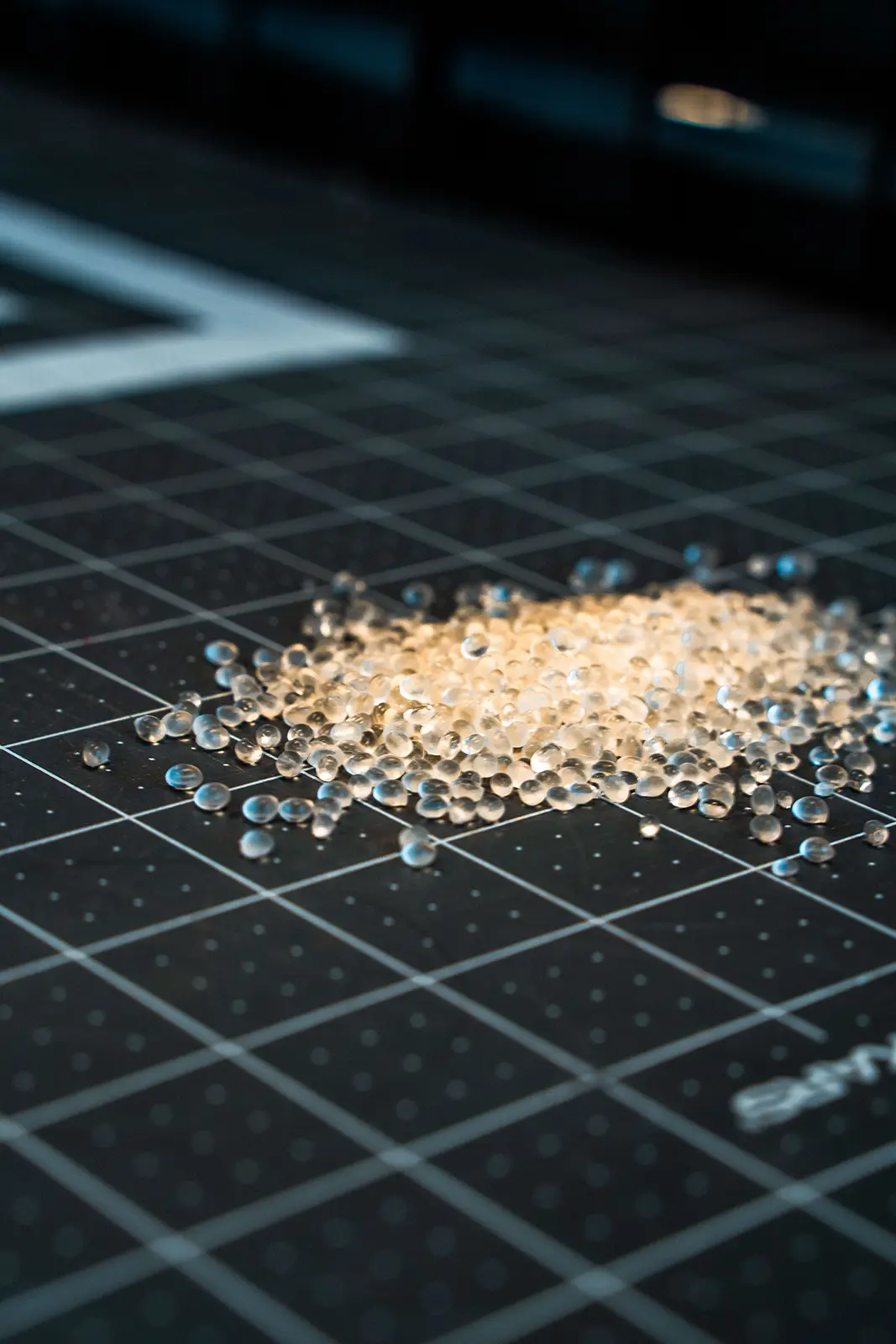
In our case as a 3D printing service provider, S2S-Systemdrucker GmbH, our speciality is printing materials in pellet form (fused granular fabrication). Here no spooled material is fed in; the material is present in its raw form as pellets.
The advantages and possibilities for industry are obvious:
Cost savings: the process is considerably cheaper, since we can buy the material directly as a raw material – in large quantities, exactly as is familiar from the injection moulding industry. The expensive refinement step into filament disappears.
Speed: extrusion screws allow us to dispense material faster and in larger volumes. That makes it possible to produce parts in a fraction of the time.
Material variety: we can draw on certified standard industrial pellets without having to wait for special 3D printing variants.
A detailed overview: materials and types of plastic in 3D printing
Choosing the right material determines whether a project succeeds or fails. Every type of plastic has its own field of application, specific functions and individual advantages and disadvantages. Below we give a detailed overview of the most relevant 3D printing materials.
1. Standard plastics: PLA and PETG
Polylactic acid (PLA)
PLA (polylactide) is often the entry point into the world of 3D printing. It is a bio-based plastic obtained from renewable raw materials such as corn starch. Biochemically it is synthesised via lactic acid, producing a biopolymer.
Properties: very high surface hardness, faithful reproduction of detail, little warping.
Disadvantages: PLA is brittle and has a low softening temperature (from around 60 °C).
Use: model making.
Polyethylene terephthalate glycol (PETG)
PETG is the glycol-modified variant of the familiar PET we know from the drinks industry. The “G” stands for glycol, which is added to prevent crystallisation and improve printability.
Properties: more flexible than PLA, higher temperature resistance (up to around 75–80 °C), good chemical resistance, food safe (depending on the manufacturer).
Processing: it is easy to process and offers excellent layer adhesion.
Use: functional parts, mechanical fixtures, protective covers.
2. Engineering plastics
Industrial applications quickly move into territory that is considerably more demanding and calls for “real” technical properties. Materials such as ABS (acrylonitrile butadiene styrene) and ASA dominate here.
Acrylonitrile butadiene styrene (ABS)
ABS is a classic of plastics engineering (familiar from LEGO bricks, for instance). It is an amorphous thermoplastic made up of three monomers: acrylonitrile, butadiene and styrene.
Mechanical properties: high impact strength, a scratch-resistant surface, good temperature resistance (up to around 90–100 °C).
Challenges: ABS shrinks significantly as it cools. That leads to internal stresses and warping. A 3D printer for ABS absolutely requires an enclosed, ideally heated build chamber and a heated print bed.
Post-processing: ABS machines extremely well (drilling, sanding) and can be smoothed chemically (with acetone vapour, for instance).
Acrylonitrile styrene acrylate (ASA)
Because ABS yellows and becomes brittle under UV radiation (sunlight), ASA was developed. It is an almost identical plastic in which the butadiene component has been replaced by acrylate rubber.
Advantage: ASA is extremely resistant to weathering and UV.
Use: outdoor housings, vehicle parts, outdoor applications.
Polyamide (PA / nylon)
Polyamides are among the most important engineering thermoplastics. They are semi-crystalline and stand out for excellent toughness and chemical resistance.
Properties: high abrasion resistance, a low coefficient of friction, high fatigue strength.
Challenge: PA is strongly hygroscopic, meaning it draws water from the air. Damp material leads to a poor surface and reduced strength. Professional material drying before processing is mandatory.
Variants: PA6, PA12, PA6.6. Often used in laser sintering (SLS), but increasingly in FFF and pellet printing too.
3. High-performance polymers
For applications once reserved for metal, high-performance polymers are used today. These categories are the top of the pyramid.
PEEK (polyether ether ketone)
PEEK is one of the most capable thermoplastics in the world.
Performance: continuous service temperatures up to 260 °C, extreme chemical resistance, excellent tribological properties (sliding behaviour), biocompatible.
Processing: requires extremely high print temperatures (nozzle > 400 °C, build chamber > 100 °C). PEEK is semi-crystalline, which makes process control demanding.
Industry: aerospace, medical technology, oil & gas, a replacement for metal parts.
PEI (Ultem)
Ultem is an amorphous high-performance plastic with high transparency (amber-coloured) and extreme strength.
Advantage: it has outstanding flame-retardant properties (UL94 V-0 certification) and low smoke emission, which makes it ideal for aviation and rail transport.
4. Flexible materials and elastomers
Thermoplastic polyurethane (TPU)
TPU belongs to the class of thermoplastic elastomers (TPE). It combines the properties of rubber with the processability of thermoplastics.
Properties: high elongation at break, flexible, damping, resistant to oils and greases.
Variants: available in various Shore hardnesses.
Use: seals, damping elements, flexible hoses, grips.
Additives and modification of plastics
Pure polymers (base polymers) are rarely used on their own in industry. To optimise mechanical properties or processability, they are blended with additives (compounded).
Fibre reinforcement
A major topic in the development of new materials is the addition of fibres. Short or long fibres of glass or carbon are embedded in the matrix (nylon or ABS, for example).
The effect of the fibres:
Increased stiffness (Young's modulus) and tensile strength.
Reduced thermal expansion (less warping).
Increased heat deflection temperature.
These fibres partly break up the directionality (anisotropy) of material properties that arises from layer-by-layer building, and give more homogeneous part properties.
Functional additives
Lubricants & plasticisers: improve flow in the extruder.
Adhesion promoters: provide better hold on the print bed.
Colour masterbatches: allow any desired colour (RAL/Pantone), which is particularly easy to achieve in pellet printing.
Flame retardants: for fire protection applications.
ESD additives: conductive particles (carbon black, carbon nanotubes) make the plastic electrically dissipative in order to prevent static charge (important for electronics housings).
Challenges in processing and quality assurance
Although 3D printing is a mature process, many challenges arise in everyday practice, since separate process parameters have to be set for every plastic and often even for every plastics manufacturer. It is very much a field in its own right.
Thermal management and crystallisation
As mentioned at the outset, amorphous and semi-crystalline plastics behave differently. With semi-crystalline materials such as PEEK or polyamide, the cooling curve has to be controlled precisely. If the material cools too quickly, no perfect crystals form, which reduces chemical resistance and strength. If it cools too slowly or unevenly, severe warping results. The heated chamber of modern industrial systems is therefore not a luxury but a physical necessity.
Anisotropy: the layer problem
A 3D-printed part usually has lower strength in the Z direction (perpendicular to the layers) than in X and Y. The fusion of each layer to the one beneath is the critical point. High print temperatures and optimised chamber heating can minimise this effect, so that almost isotropic properties (as in injection moulding) can be achieved.
Fields of application in industry
The variety of available types of plastic allows the technology to be adopted widely across very different sectors:
Automotive: prototyping, fixtures, assembly aids, spare parts for classic cars (from ASA or PA, for instance).
Mechanical engineering: grippers, brackets, bespoke tools made from wear-resistant materials.
Medical technology: orthoses, prostheses, surgical guides (biocompatibility required).
Electronics: housings for sensors, ESD-safe brackets.
Outlook: the future of 3D printing materials
The development of new materials is advancing rapidly. We see a trend towards high-temperature materials and certified compounds that meet the demanding requirements of the aviation and rail industries. At the same time sustainability is becoming more important: recycling of plastics and the use of regrind (rPLA, rPET) is increasing.
For service providers and manufacturers such as S2S-Systemdrucker GmbH, that means staying technologically up to date at all times. Using pellet printers, we are able to adopt new material developments from the chemical industry immediately, without waiting for filaments to become available.
Conclusion
The choice of plastics for 3D printing is greater today than ever before. From low-cost PLA through robust ABS acrylonitrile butadiene styrene to the high-performance polymer PEEK, additive manufacturing covers almost every requirement. The key to success lies not only in the printer but in a deep understanding of materials science.
With pellet processing technology, S2S bridges the flexibility of 3D printing and the material variety and cost efficiency of injection moulding. That allows us to produce series and large parts economically.
Frequently asked questions (FAQ) about 3D printing plastics
Which is the strongest material for 3D printing?
Among standard engineering plastics, carbon-fibre-reinforced polyamide (PA-CF) and ABS often offer the best ratio of price to mechanical performance.
Why are pellets often used instead of filament in industrial 3D printing?
Pellets are the standard form of most plastics. Processing them into filament is an additional, expensive production step. Pellet printing (FGF) is therefore considerably cheaper on material purchasing, enables higher deposition rates (faster printing) and offers an enormous choice of materials.
What is the difference between ABS and ASA?
Mechanically the two are very similar and robust. The main difference lies in UV resistance. ABS yellows and becomes brittle under UV light (sunlight), whereas ASA was developed specifically for outdoor applications and remains UV-stable.
Author: Jonas Siegrist
Company: S2S-Systemdrucker GmbH