
When people talk about 3D printing, most think first of rigid plastic parts, housings or technical components. In fact, though, additive manufacturing also opens up entirely new possibilities with flexible materials and textiles. Together with a partner from the textile research sector, we are currently looking at how flexible plastics can be printed directly onto a wide range of fabrics and what new applications that could create.
The challenge: adhesion and flexibility at the same time
The real challenge is not applying a material to a fabric. What matters far more is that a durable bond forms between the printed material and the textile while the flexibility of the overall system is retained. If the bond is too weak, the material comes away from the fabric. If it is too stiff, the textile loses its essential properties and becomes uncomfortable or unusable for its intended purpose.
Textiles tested: from cotton to Kevlar
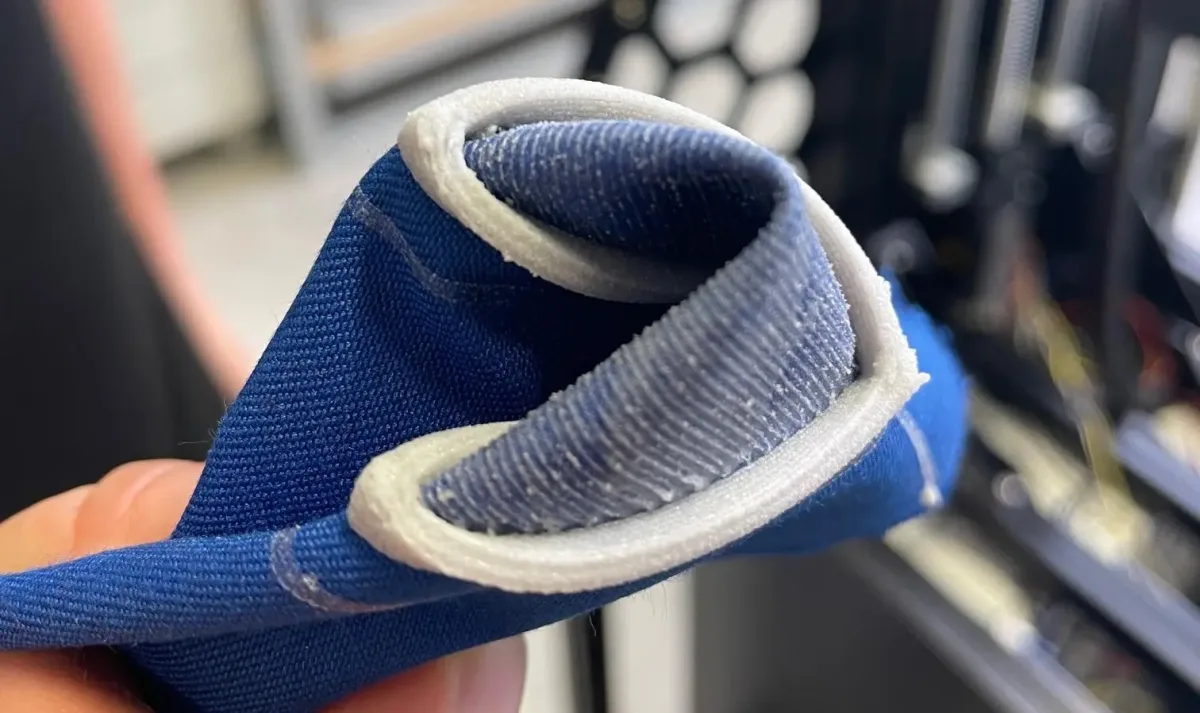
In the course of various investigations we have therefore printed onto a wide variety of textiles. These included conventional cotton fabrics, synthetic weaves, felt materials and high-strength technical textiles such as Kevlar. It became clear that with the right process parameters and materials, very good adhesion can be achieved on almost all the fabrics examined.
The material: foamed TPE with damping properties
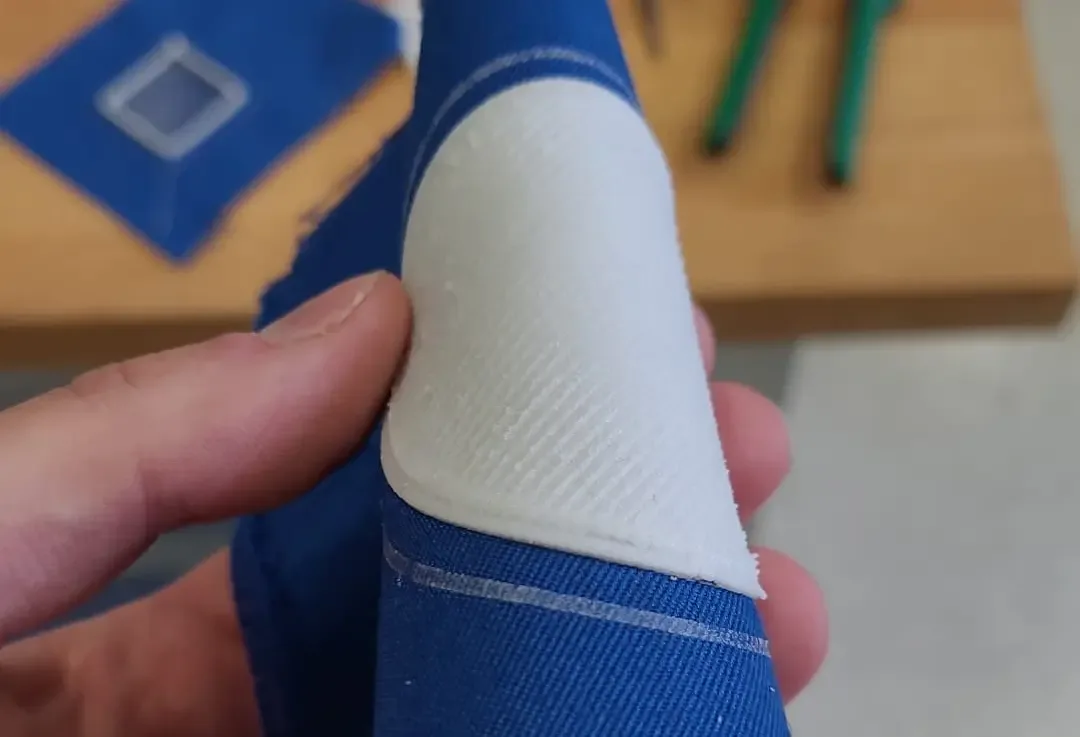
For the trials we use a modified TPE, that is, a thermoplastic elastomer processed with blowing agents. During the printing process this produces a foamed structure with low density and very good damping properties. It is precisely this combination of flexibility, low weight and energy absorption that makes the material interesting for numerous applications.
Applications in protective equipment
Exciting possibilities arise in protective equipment in particular. Individually fitted padding for helmets, knee and elbow protectors, orthoses or prostheses are all conceivable. Bonding textile and damping element directly creates a lightweight yet functional overall system that can be matched precisely to the application in question.
Printed on the MultiPrint system
The parts were printed on our MultiPrint system at S2S-Systemdrucker GmbH. The particular advantage of this system lies in its multi-head concept. While one print head can lay down large quantities of material quickly, a second print head takes care of the finer structures and contours. That makes it possible to produce larger parts economically without sacrificing detail quality. The result is short print times combined with high precision.
An extension: a rotation module as an additional axis
We are also currently working on an extension to the system: a rotation module to be integrated into the printing process as an additional axis. Instead of a flat print surface, a cylindrical base body can be clamped in place. That makes it possible to mount arm or knee protectors as blanks, for example, and then apply bespoke damping structures to them directly.
Interchangeable cylinder diameters allow the system to be adapted flexibly to different applications. Both small and larger parts can therefore be processed without extensive changeovers. At the same time this approach opens up new possibilities for individually fitting protective equipment or ergonomic components.
Application field: flexible electronics
We see another exciting field of application in flexible electronics. Flexible circuit boards are becoming increasingly important in many sectors, for example in wearable electronics, sensing or smart textiles. One challenge here is often attaching these flexible components permanently to a textile or carrier structure without restricting their freedom of movement.
3D printing offers an interesting solution here. Instead of gluing the parts on or fixing them mechanically, lattice structures or flexible retaining elements can be printed directly onto the circuit board and the fabric. The electronic components stay mobile while being held securely. The flexibility of the overall system is retained and the number of additional fasteners is reduced.
Conclusion: additive manufacturing for flexible systems
This project shows very clearly how versatile additive manufacturing has become. While conventional 3D printing is often associated with rigid plastic parts, applications in flexible and dynamically loaded systems are increasingly emerging. The combination of textiles, elastomers and additive manufacturing opens up new possibilities for protective equipment, medical applications, smart textiles and many other areas. The link between material development, mechanical engineering and applied research is what makes this field particularly exciting for us, and it will remain an important part of our development work in future.