
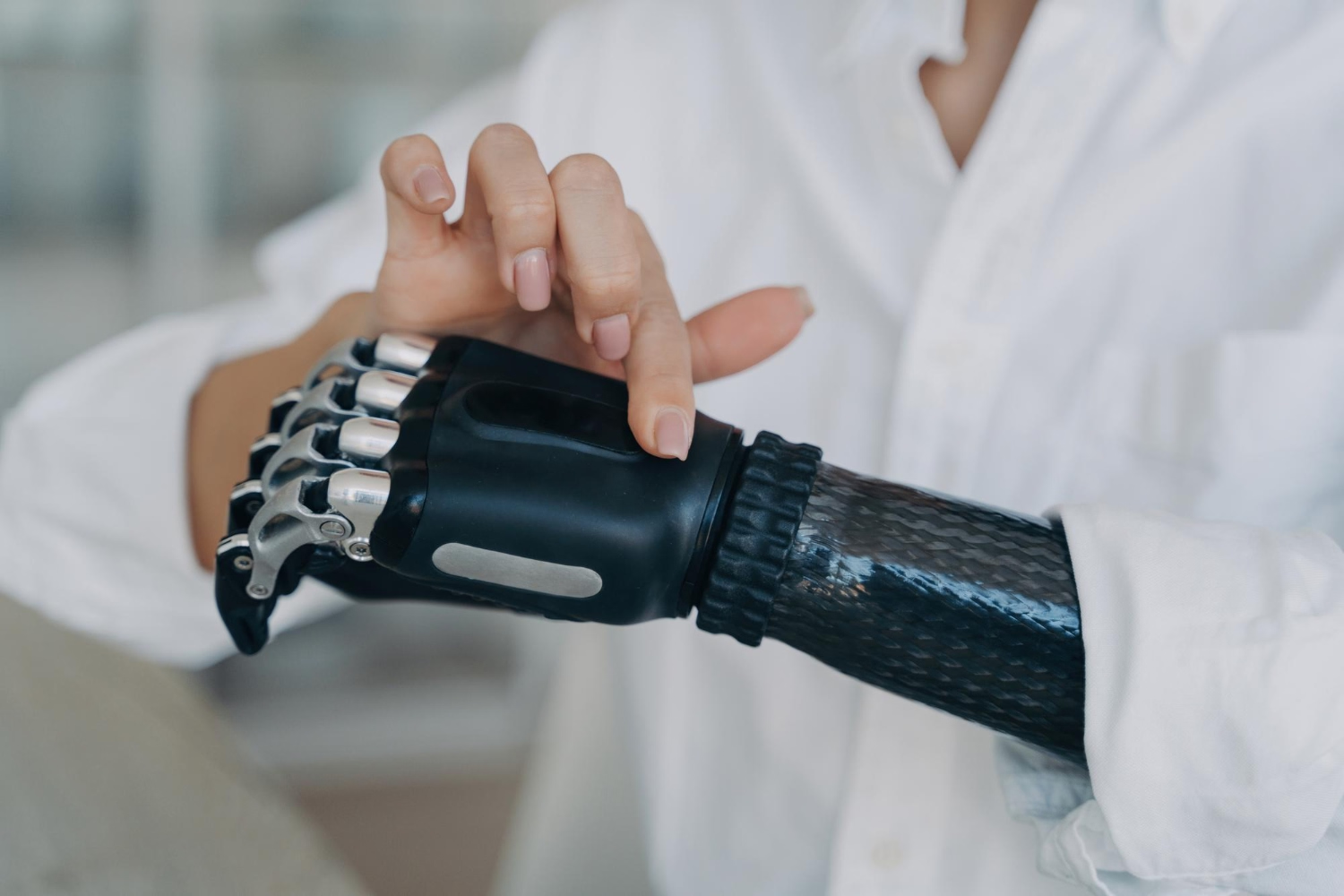
Orthopaedic technology is one of those sectors where a great deal of craft knowledge and individual fitting work is still required today. Every aid is matched to an individual patient and has to take account of their anatomical, medical and everyday requirements. It is precisely this individuality that makes orthopaedic technology a field particularly well placed to benefit from what additive manufacturing offers.
Shaped by handcraft: where things stand today
Many components are still produced today through painstaking handwork. Seating shells, prosthetic components, corsets and orthopaedic aids are fitted, reworked and often optimised over several iterations. This way of working has proved itself over decades, but it is time-consuming and ties highly qualified specialists to tasks that could in future be partly automated.
Relieving the technician, not replacing them
This is not about replacing the orthopaedic technician. Quite the opposite. Their real expertise lies in assessing the patient, choosing suitable treatment concepts and specifying aids from a medical and technical point of view. Our aim is rather to shorten the path between that expertise and the actual production.
This is exactly the interface we are currently working on together with partners from orthopaedic technology. The vision is that the orthopaedic technician simply records the relevant data and hands it over to the system. Production should then run largely automatically, without requiring deep knowledge of 3D printing.
Example: bespoke seating shells for wheelchair users
A good example of this is the production of bespoke seating shells for wheelchair users. Body contours can already be captured and measured digitally today. From that measurement data, information about load zones, pressure points or particularly sensitive areas can be derived. While such adjustments have often had to be made by hand, the aim is to carry this information directly into the printing process.
The orthopaedic technician simply defines the outer dimensions and hands over the relevant measurement data. The system then calculates the required material properties within the seating shell itself. Areas under high load can be made firmer, while sensitive zones are made softer. The result is a continuous material gradient matched precisely to the patient's needs.
Material gradients through foamed elastomers
This is made possible by using foamed elastomers whose properties can be influenced deliberately during the printing process. Our current material conveying and dosing technology allows the degree of foaming to be varied continuously. Different hardness zones can therefore be created within a single part without any additional assembly steps.
The machine architecture of the MultiPrint system
The machine architecture of our MultiPrint system supports this approach too. A large-volume print head can first build up large quantities of material quickly and thereby create the basic structure. A second print head then takes over the detailed areas and prints accurately to contour wherever higher resolution or special material properties are required. Bespoke parts are therefore produced in a comparatively short time.
Functional additives for hygiene requirements
Additional possibilities open up through the deliberate addition of functional additives. Hygiene requirements play an important role in orthopaedic technology in particular. With open skin, pressure points or sensitive areas especially, antibacterial properties can be an advantage. By blending in silver particles or other functional additives, such properties can be integrated during the printing process itself.
Long-term provision and reproducibility
Alongside production itself, the long-term provision of care for patients is an important aspect. Orthopaedic aids are often exposed to heavy loads and have to be replaced after a certain period of use. With individually fitted components in particular, the question then arises of how an identical reproduction can be assured.
For this use case we are currently developing solutions in which a pick-and-place system integrates RFID tags directly into the part during printing. Relevant information about the production file or the treatment can be stored on those tags. If a worn seating shell needs replacing, for example, it is enough to present the part to a reader. The system automatically recognises the stored specification and can call up the corresponding print file again. That makes spare part supply considerably simpler and faster.
Further applications in orthopaedic technology
The seating shell example is just one of many possible applications. The same approaches can be transferred to prosthetic components, corsets for treating spinal deformities, bandages, orthoses or damping elements for joints. Wherever individual fitting, complex geometries and functional materials come together, additive manufacturing offers new possibilities.
Conclusion: value through the digital process chain
For us this project shows particularly clearly that the future of 3D printing does not lie in the machine alone. The real value comes from linking expertise, digitalisation, material development and automated production. In orthopaedic technology in particular this can simplify processes, reduce production times and deliver individual care more efficiently, without having to do without the experience and competence of the specialists.