
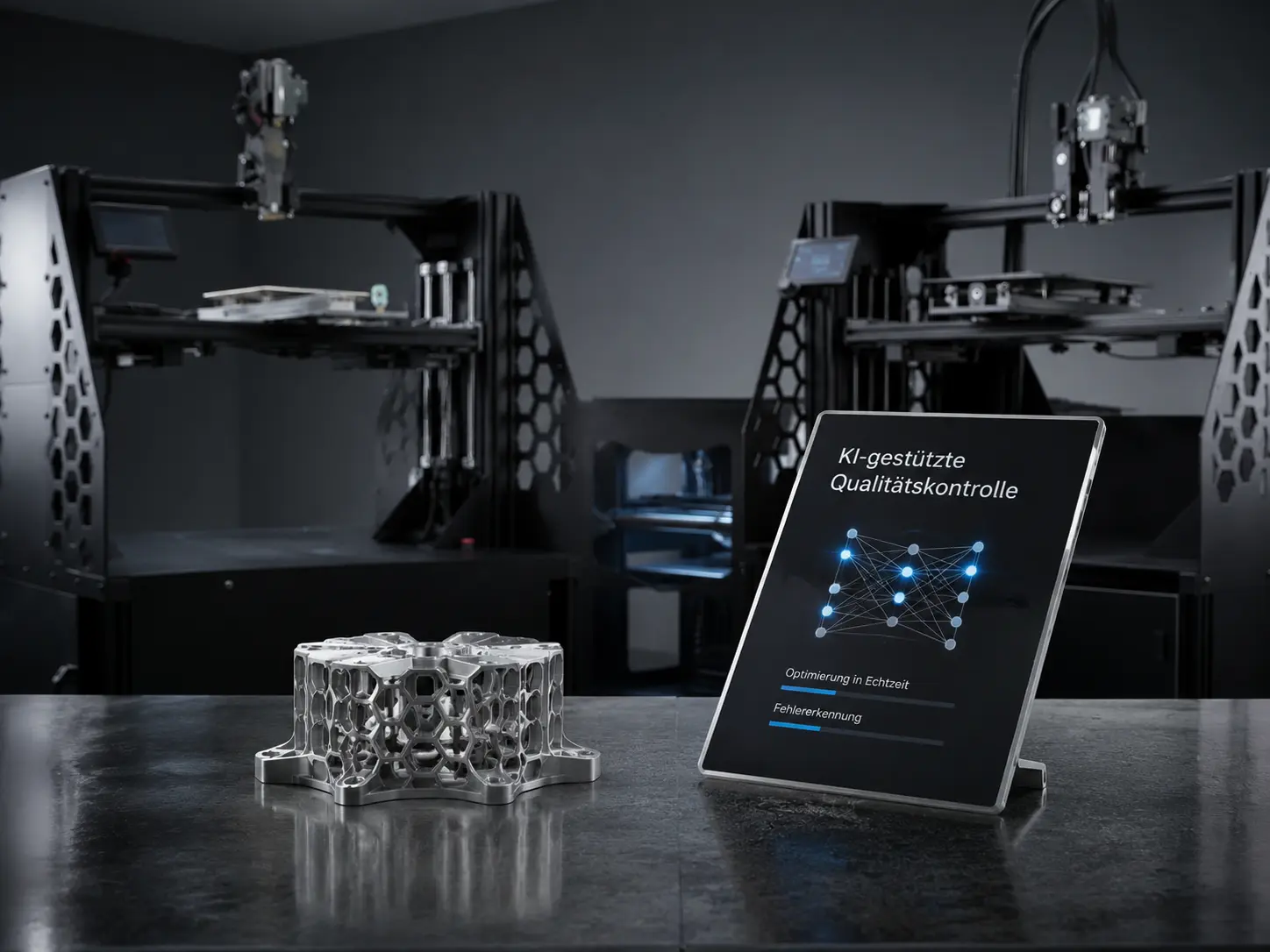
Artificial intelligence is passing no industry by – and industrial 3D printing is no exception. At S2S-Systemdrucker GmbH we are looking hard at the question of where AI creates real value in pellet-based 3D printing. Because we see AI as a major opportunity: even today's state of development opens up applications that genuinely make sense for industry and research. In this article we work through a concrete scenario – from the idea to a print-ready part.
The starting point: yes to AI, but with a sense of proportion
First of all: you always have to check how mature an AI solution is for the particular purpose at hand. Not every hype delivers what it promises. But the current state of the art is already advanced enough that using it in clearly defined use cases pays off – provided the solution is tailored to the specific requirements of the business.
The scenario: a company wants to design parts
Let's assume a company comes to us needing a machine with which new parts will be regularly designed and produced. This is where a so-called RAG model (retrieval-augmented generation) comes in: on the basis of this technology, a company's own knowledge base for design work can be built up – with all of the business's specific values, standards, design guidelines and accumulated experience.
With every query the AI draws on exactly this company knowledge instead of falling back on general training alone. The result: answers and models that fit the company.
Control over your data: AI can run locally
One point that matters a great deal to us – and that must never be neglected in industry and research in particular: an AI like this can be run entirely locally. That means no company secrets end up on someone else's servers. Design data, material recipes and process parameters stay in house, and the company retains full control over its data.
You do not need an all-encompassing cloud AI such as ChatGPT or Claude for this. A specialised, locally hosted RAG model tailored specifically to the requirements of the industrial business or research institute often delivers better results for the specific use case – and in every case safer ones.
From a spoken command to a 3D model
The workflow could look like this: an engineer wants to design a new part. Instead of starting from scratch, they describe the part in natural language – the more specific and precise the description, the better the result. The AI compares the requirement with the company database and produces a first draft model from it.
A realistic note: AI-assisted generation of 3D models from natural language is still at an early stage for precise engineering parts. Today it primarily delivers drafts and starting points that a specialist then reworks – not production-ready designs at the touch of a button. With every new generation of models, however, the approach becomes more practical, and anyone who puts the foundations in place today, such as a structured company database, benefits directly from that progress.
Via a suitable interface – and here our Klipper host extensions come into play again – that model can then be translated into G-code, so that in theory the printing system could produce the part directly.
People stay responsible
One thing matters to us here: there are deliberate intermediate steps between the AI draft and the finished print. The generated model is first visualised in the slicer, because the engineer has to check: what does the part look like? Do the specifications hold? Did the AI read the requirement correctly – or not?
In this workflow AI is an accelerator, not a substitute for engineering competence. The technical review and the final decision stay with people.
A further use case: AI-assisted calibration
A second field with great practical value is machine calibration. Every machine is calibrated with particular values – a process that takes experience and time. An AI trained on the history of past calibrations and print projects can give valuable recommendations here: which values have proved themselves in comparable situations? Which parameters promise the best result?
This gets you to a very good set of parameters considerably faster – and saves valuable time that would otherwise go into iterative test runs.
Conclusion
AI in 3D printing is not a distant prospect: local RAG models as a company knowledge base and AI-assisted calibration recommendations can already be implemented sensibly today, while fully automatic design by spoken command is the goal development is visibly heading towards. What matters is the right balance – between the possibilities of the technology, the company's control over its data and oversight by the specialist.
Would you like to find out which AI use cases make sense in your production? Get in touch – we are happy to think through with you what is already possible.