
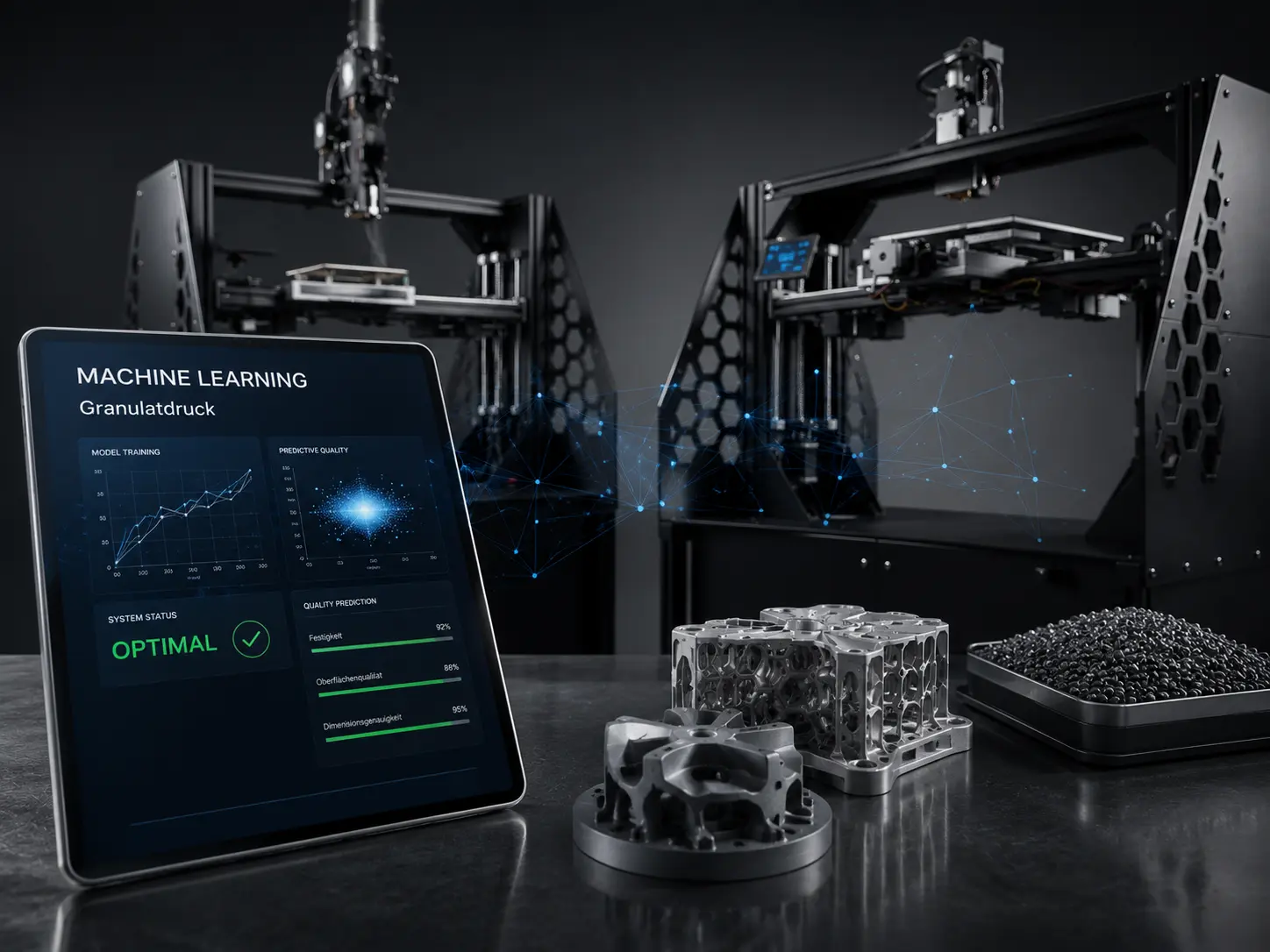
Machine learning at S2S-Systemdrucker GmbH is a broad, highly specific and deep subject – and one that can make pellet-based 3D printing fundamentally more efficient. In this article we explain how we use machine learning models to find the optimal parameters for demanding materials such as ferrites, technical ceramics or material blends – and why our approach deliberately relies on classical machine learning rather than generative AI.
What is machine learning – briefly explained
Put very simply, machine learning works like this: a neural network is trained using iterative training loops and systems of mathematical equations. The trained network can then make decisions or deliver predictions on the basis of any number of input parameters – and the more high-quality training data available, the better it does so.
For 3D printing this becomes interesting precisely where a task traditionally requires a great deal of experience, time and iterative test runs: setting the parameters.
The challenge: every material and every requirement is different
A typical project with us starts like this: a company comes to us and says, “we need these particular properties in the printed part, and all of it has to be done with this specific material.”
Then our actual work begins: how do we set up the machine? How do we configure the pellets, the blend, the throughput rates? In pellet-based printing with technical materials in particular, the parameter space is vast – temperatures, flow behaviour, mixing ratios and material properties all interact. Traditionally you approach the optimal setting through test runs. That works, but it costs time and material.
Our approach: learning from every project
This is where our machine learning models come in. We have a growing treasure trove of data: completed projects, our material database, our parameter database. On that basis we train models that learn exactly these relationships.
In a new project it then looks like this: we give the model the input parameters of the customer's project – the desired part properties, the material, the boundary conditions. The trained model analyses these inputs and, based on its training, proposes a set of parameters: mixing ratios, throughput rates and other process variables. Instead of starting from scratch, we start with a well-founded, data-based recommendation – and considerably shorten the route to the optimal setting.
The risk of overfitting – and how we counter it
Anyone working with machine learning needs to know about one problem and take it seriously: overfitting. Here a model effectively memorises the training data instead of generalising the underlying relationships. The consequence: it delivers excellent results on known data but fails on new, unfamiliar combinations. With process data from manufacturing in particular, which by its nature is not available in unlimited quantities, this risk is real.
We therefore built mechanisms into our training processes from the outset that prevent overfitting – so that our models deliver reliable recommendations for new material combinations and requirements too, rather than merely reproducing the past.
Important: classical machine learning rather than generative AI
One point that matters to us: machine learning is formally a sub-field of artificial intelligence – but what we use here has nothing to do with what is usually meant by “AI” today, that is, language models or generative AI. Our machine learning processes are based on mathematical formulae and clearly defined training procedures. The neural network extends its knowledge along learning curves that we steer deliberately and adjust at defined points.
The decisive difference: we have the process in our hands. The behaviour of the models is traceable, the training is controlled, the results are reproducible. For industrial use – where reliability matters more than spectacular demos – that is exactly the right approach.
Conclusion
Machine learning turns our project experience into an active tool: every completed project, every data point from the material and parameter databases improves the recommendations for the next one. For our customers that means shorter ramp-up phases, less material consumed in test runs and reproducible results more quickly – including, and especially, with demanding materials.
Do you have a project with special material requirements? Get in touch – our model may already have learned most of the right parameters.