
Open firmware as the foundation for industrial 3D printing systems.
Anyone developing an industrial 3D printing system faces a fundamental decision early on: go with proprietary, closed control software – or with an open system? At S2S-Systemdrucker GmbH we deliberately chose Klipper. In this article we explain why that decision is the right one for us and, above all, for our customers.
What is Klipper?
Klipper is an open-source firmware for 3D printers and is today one of the most widely used and most actively developed firmware solutions on the market. Unlike conventional firmware, Klipper moves the computationally intensive motion planning off the printer's microcontroller and onto a more capable host computer – typically a single-board computer such as a Raspberry Pi. The microcontroller merely executes the precisely timed control commands.
This architecture brings decisive advantages: higher precision, more computing power for complex kinematics and – particularly important for us as a machine builder – excellent extensibility at the software level.
Open source: no gatekeeping, no isolated solutions
The most important reason for our decision is the openness of the system. Klipper is open source and is developed further by a large, active community. Anyone working professionally with 3D printing can hardly avoid Klipper – and the expertise available on the market is correspondingly broad.
For our customers that means maximum independence. Our systems should be accessible and operable by anyone – without artificial hurdles, without vendor lock-in, without a proprietary black box. A customer running our machines can bring in their own developers at any time, who can understand, maintain and even extend our Klipper integration themselves. The documentation is public, the knowledge is available on the market, and the codebase can be inspected.
That is a deliberate counter-model to closed systems, where the machine operator depends on the manufacturer for every change. At S2S we do not want to act as gatekeepers or build isolated solutions. We want to deliver machines that give our customers flexibility and investment security in the long term.
An architecture that grows with you
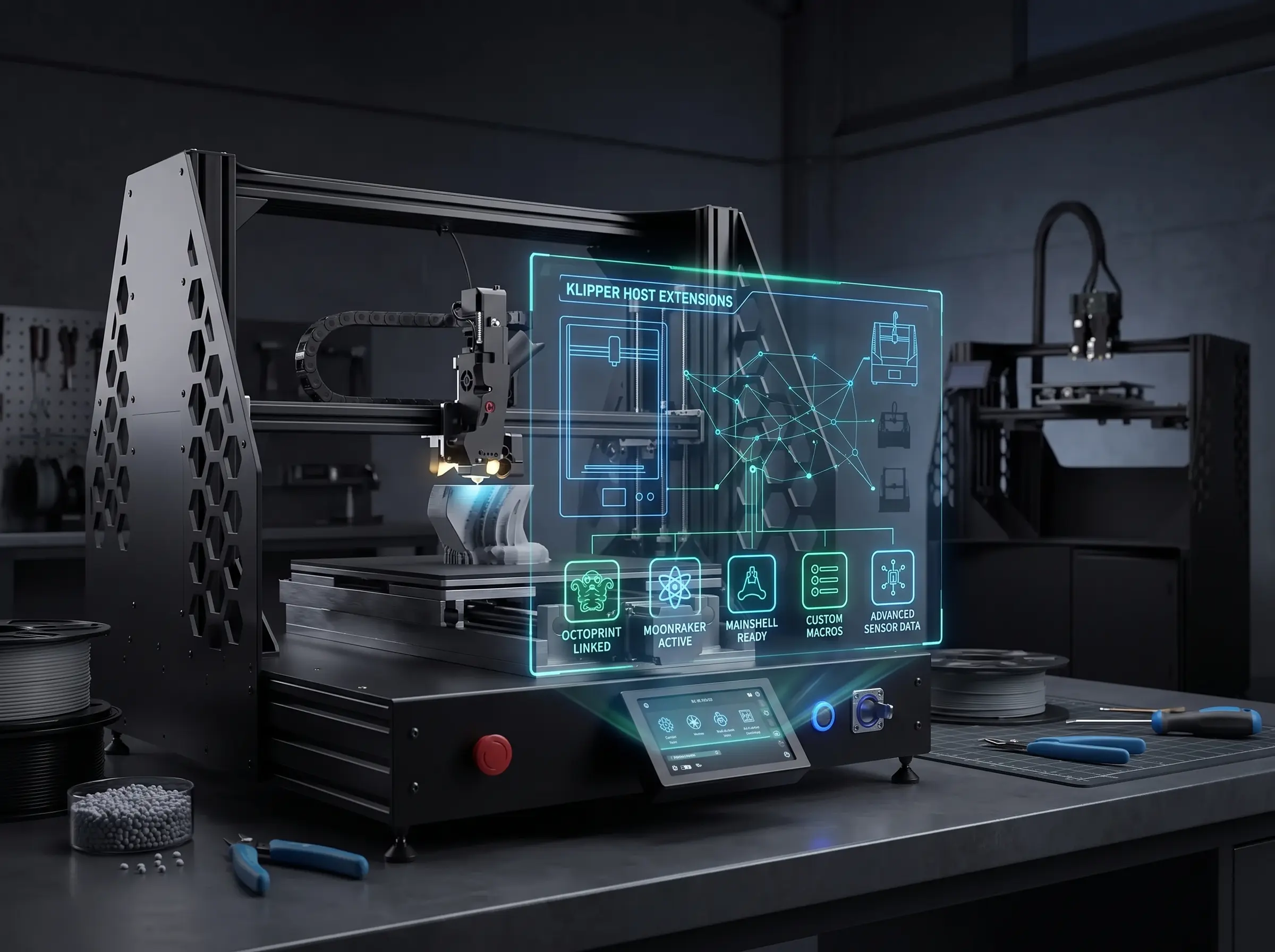
Klipper is not only open but also technically mature. The structure, architecture and operating principles of the firmware are well thought through – and the scope for extending Klipper is exceptionally good. So-called host extensions (modules on the host computer) make it possible to implement bespoke functions: custom sensors, customer-specific process monitoring, alerting systems or tailored user interfaces.
In pellet-based 3D printing in particular – our speciality at S2S – that extensibility is decisive. Anyone processing materials such as ferrites, technical ceramics or material blends works with process parameters and sensors that go far beyond conventional filament printing. A closed system would simply tie our hands here. With Klipper we can tailor every machine precisely to the customer's application.
Of course nothing is perfect
In fairness: Klipper has weaknesses too. Like any software it comes with quirks you need to know about and allow for. From our point of view, though, these are entirely acceptable trade-offs – especially compared with the restrictions a proprietary system would bring. The advantages in terms of openness, extensibility and community support clearly outweigh them.
Conclusion: openness as a principle
Our decision in favour of Klipper is more than a technical preference – it expresses our philosophy. We rely on proven, widely used and excellently documented open-source software because it guarantees our customers genuine control over their data, adaptability and independence. And because it gives us as developers the freedom to build the right solution for every requirement.
Would you like to find out more about how we use Klipper in our pellet-based 3D printing systems? Get in touch – we are happy to show you what is possible with an open system.