
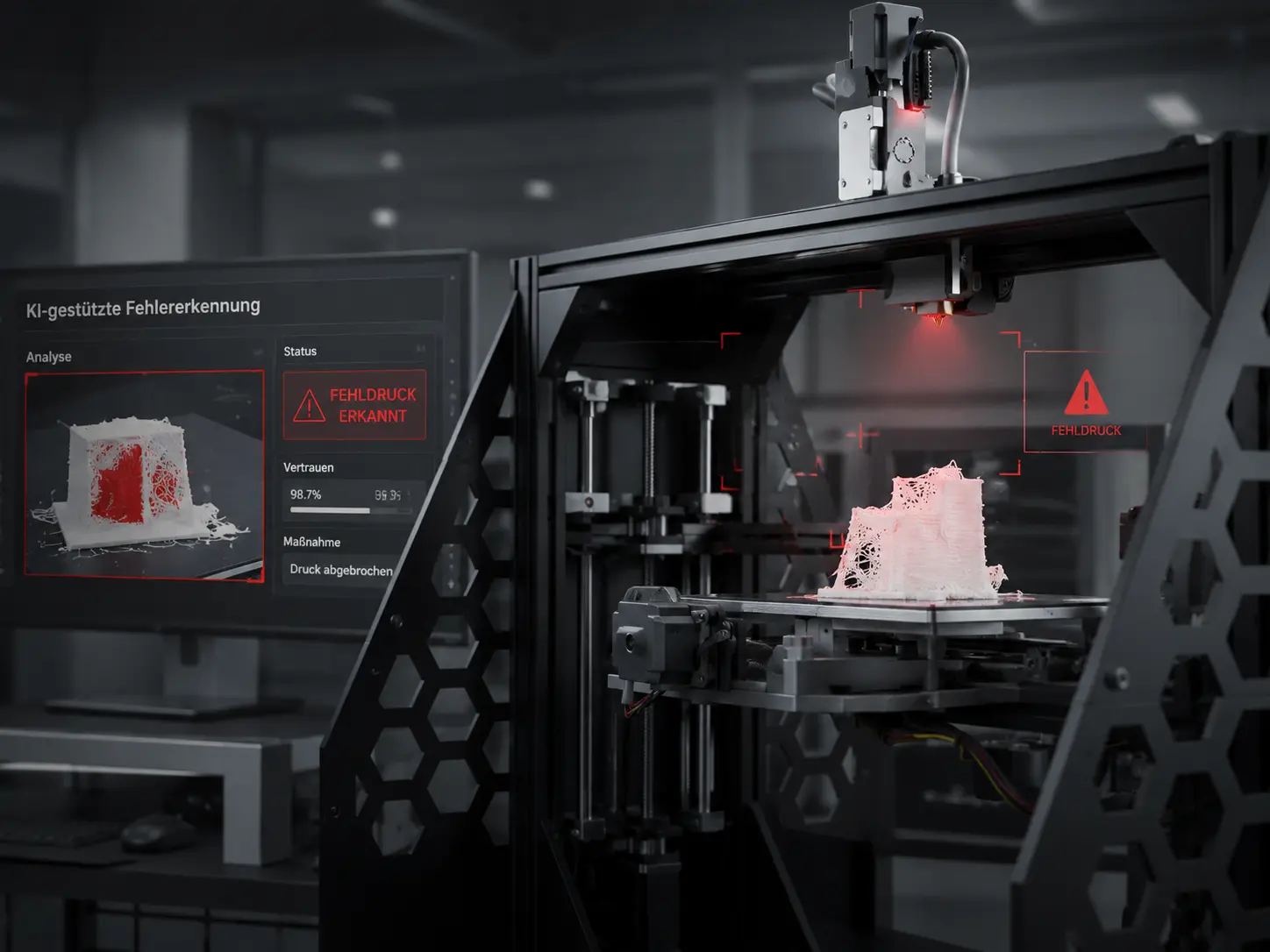
Failed prints cost time, material and, in the worst case, entire production orders. In industrial pellet-based 3D printing in particular – where materials such as ferrites, technical ceramics or material blends are processed – every failed print is expensive. That is why, at S2S-Systemdrucker GmbH, we are working on a camera-based monitoring system that uses AI and neural networks to spot print failures early. In this article we give you a look inside that internal research project.
More than conventional fault detection
The obvious job of a system like this is clear enough: notice when something goes wrong. A printed part has come loose, the printer is laying down faulty paths, extruded pellets have become caught – these are all classic failure patterns that a camera combined with a trained neural network can detect reliably. Once such a fault is recognised, the machine can respond automatically: pause the print, alert the operator or abort the job in a controlled way.
Our approach, however, goes considerably further. We are not only interested in the question “is the print running?” but above all in: how good is the print quality?
Assessing print quality systematically
The core of our research project lies in assessing print quality systematically as a function of the parameters used. The approach works like this: we define various parameter sets and run test prints at defined intervals – that is, in steps of differing size. Our AI learns from every single print.
The goal is a system that, after sufficient training, can make precise statements such as “parameters X and Y in this ratio are optimal for exactly this application.” That turns the camera from a monitoring tool into an active instrument of process optimisation.
Context counts: sensor data as a second dimension
An image on its own only tells half the story. Alongside the camera monitoring, we therefore record every value our machine logs during the print: did temperatures change? Were there vibrations? Did external conditions shift?
All of this data is transferred, together with the camera data, into a structured data format we can work with systematically. That makes it possible later to establish not just that a fault occurred, but also why. On that basis, targeted optimisation and troubleshooting can be set in motion – driven by data rather than gut feeling.
Looking ahead: automated series production
This approach becomes particularly interesting in series production. Imagine a print job of 10,000 parts. With our system, the entire production run is monitored continuously by the camera. At the end there is a solid evaluation: of 10,000 parts produced, 100 were faulty, for example – including the information about the conditions under which those faults occurred.
That opens up prospects for largely automated quality assurance: complete documentation, automatic scrap rates, traceability of process deviations. For industrial customers who depend on reproducible quality, that is a decisive benefit.
Status: research with a clear goal
At present, camera-based print failure detection at S2S is an internal research project. We try a great deal, we keep learning, and above all we collect one thing: data. Because the larger and more varied the data basis, the more precise the evaluations become – and the closer we get to the goal of an intelligent, self-monitoring printing system.
Do you have questions about our approach, or would you like to know what camera-based quality assurance could look like in your production? Get in touch – we are happy to talk.