
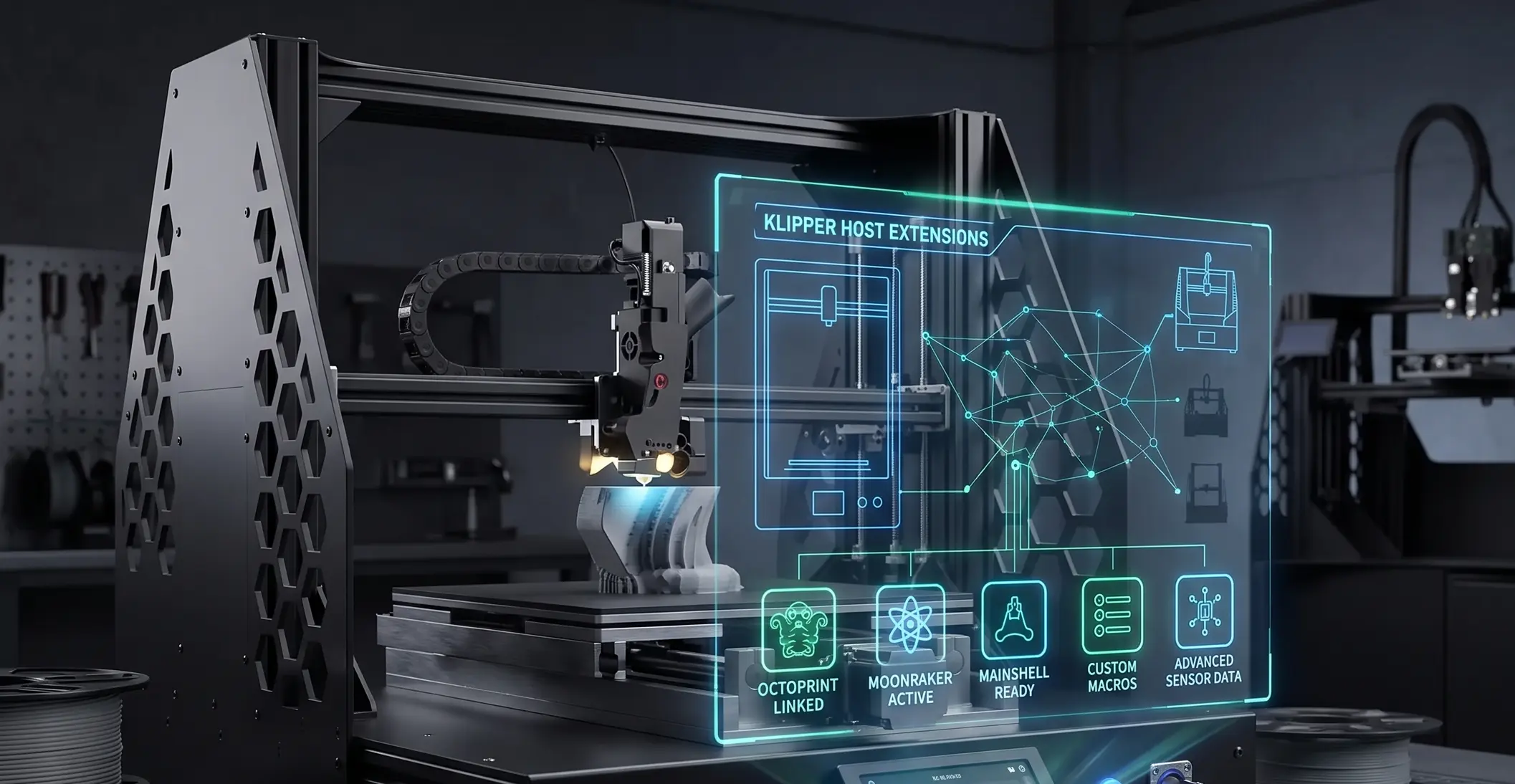
“Anything is possible” – we say this often and gladly at S2S-Systemdrucker GmbH. It refers to the software side of our machines, and it is not a marketing slogan but a direct consequence of our technology decision: we use Klipper and its host extensions. What that means in practice, and what it opens up for our customers, is the subject of this article.
What are host extensions?
Klipper, the open-source firmware behind our pellet-based 3D printing systems, provides a dedicated area for add-ons: so-called host extensions. These are modules that run on the machine's host computer and allow bespoke functions to be developed right down to the hardware level.
Put simply: host extensions are the interface through which we can equip every machine with exactly the capabilities a customer needs – without touching the core firmware and without depending on a closed manufacturer ecosystem.
Bespoke sensors to the customer's specification
The most important use case for us as a machine builder is integrating customer-specific sensors. Every machine we develop can be fitted with a wide variety of sensors according to the customer's requirements. Host extensions read those sensors, record their data and integrate them into the machine control.
The result is more than a collection of readings: it is a holistic, comprehensive integration of new system building blocks, from which we can draw solid conclusions about the printing process. With demanding materials such as ferrites, technical ceramics or material blends in particular, precise process monitoring is decisive for part quality.
What is possible in practice
The range of functions that can be implemented is enormous. A few examples from our work and development:
- Alerting systems: if a print fails, the machine owner or operator is notified automatically – without anyone having to stand in front of the machine permanently.
- Maintenance and consumption monitoring: the machine reports of its own accord when pellets or other print media are running low, enabling forward-looking material planning.
- Monitoring of external influences: unusual vibrations or other changes in the environment are detected and reported before they affect print quality.
- Camera integration: camera systems for optical process monitoring and print failure detection can be connected directly to the machine control.
- Bespoke interfaces and remote access: host extensions allow custom user interfaces to be built – as a mobile app, a desktop application or even as a link to messaging services such as Telegram. The operator can request status information or issue defined commands, wherever they happen to be.
Freedom through openness
All of these possibilities share one prerequisite: the openness of Klipper. If we used a closed system, our hands would be tied in every one of these use cases – each extension would depend on the goodwill and roadmap of a firmware vendor.
With Klipper and its host extensions, by contrast, we can fulfil practically any request a customer makes. There is one limitation, of course: hardware is physically limited – not every mechanical requirement can be met arbitrarily. But on the software side, wherever Klipper host extensions are involved, there is in our view nothing that would not be possible.
Conclusion
Host extensions are the tool with which we turn standardised firmware into a tailor-made industrial system. For our customers that means maximum flexibility today and extensibility for tomorrow's requirements.
Do you have a specific requirement for the sensors, monitoring or operating concept of your printing system? Get in touch – chances are high that we will say: anything is possible.