
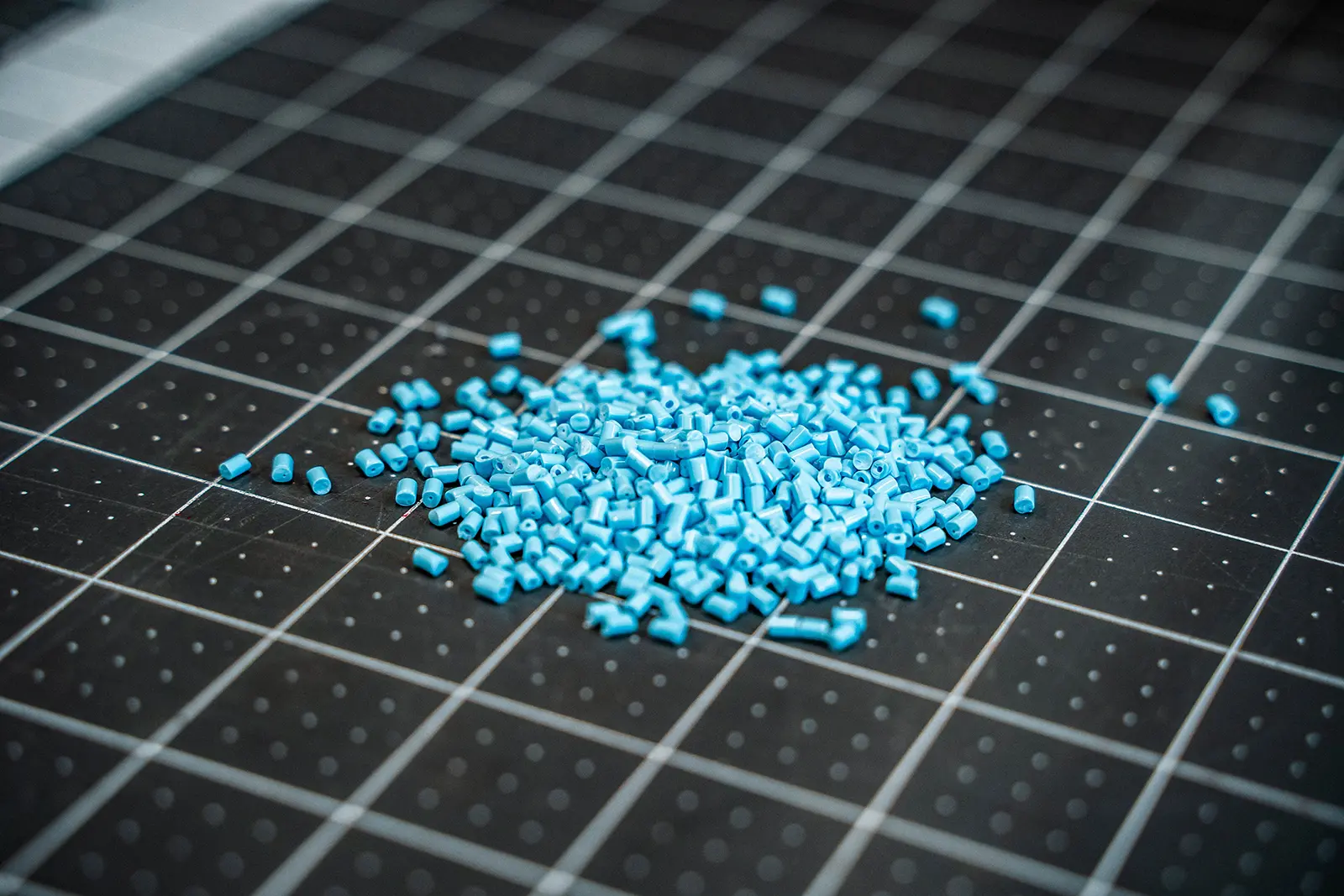
Plastics recycling is no longer a fringe topic – it is an industrial necessity. At the same time, additive manufacturing opens up new ways of putting regrind to sensible use in technical manufacturing processes. This article is aimed at decision-makers, engineers and technical managers who want to understand how recycling works in the context of 3D printing – and where the real potential lies.
Why plastics recycling is strategically relevant today
Recycling plastics is a broad field that has gained enormous importance in recent years. The images of plastic waste in the oceans or on beaches are the visible symptom of a systemic problem: worldwide we produce tonnes of plastic every day – a material that in many cases is used only once, even though in theory it could be processed several times over.
There are around 200 different types of plastic on the market. Only about six main types are currently recycled effectively through household systems – above all PE and PP in packaging. Engineering plastics, high-performance polymers and fibre-reinforced materials barely pass through that process. Industrial sorting is based on physical properties such as density or infrared detection; engineering materials are hard to identify and separate that way.
In industry, moreover, it is not a matter of a few kilograms of leftover material but of tonnes of sprues, scrap and production waste. Producing high-quality regrind under real storage conditions – weather, moisture, contamination – is technically demanding. The challenge is solvable but requires competence in materials science, process control and documentation.
The mechanics of materials: what happens when polymers are recycled?
Plastics consist of long polymer chains that largely determine their mechanical characteristics. On remelting – whether when preparing regrind or in the printing process itself – these chains are subjected to thermal and mechanical stress and can shorten. In theory that means: the more often a plastic is recycled, the more its material characteristics might change.
In practice, however, materials testing shows that recycling once or several times causes no significant deterioration in mechanical characteristics in many cases. What often does change is the processing behaviour. Regrind can be more slippery, adhere more to tooling, show altered flow behaviour or have a different viscosity.
Important in practice: the mechanical characteristics of regrind often remain more stable than people subjectively assume. The greater challenge lies in adapting the process during production – not in the finished part.
Processing behaviour as the real variable
In material extrusion the plastic is melted and deposited layer by layer through a nozzle. Each layer adheres to the previous one – this layer-to-layer bonding is decisive for part strength and also influences the achievable geometry of the part. With regrind, the altered flow behaviour of the print material affects exactly this process. Nozzle temperature, print speed and feed rate have to be matched carefully to the material in question in order to ensure consistent layer heights and good adhesion.
Material purity – the central factor in industrial recycling
One of the most important points in plastics recycling is material purity. Ideally you want identical material types, identical colour batches and no foreign matter. As soon as different polymers are mixed, material combinations arise with unpredictable processing behaviour – critical both in material preparation and in the printing process. Mixing colours also means the material can no longer be used reproducibly.
For technical parts with defined requirements, material purity is therefore not optional but a prerequisite. Professional recycling is always a matter of documentation, material separation and process control.
Requirements for single-type regrind
- The same polymer type and material composition with no foreign additions
- Consistent colour batches – mixing colours prevents reproducible parts
- Clean storage: moisture, dirt and UV radiation degrade the materials
- Drying the material before processing
- Complete documentation of material origin and process history
Policy requirements: both a challenge and a driver of innovation
In Germany and at European level, rising recycled-content quotas are being anchored in regulation. For certain sectors – particularly packaging and injection moulding – recycled proportions of 30 % and more are being discussed or already implemented. That presents companies with concrete challenges:
- Colour stability and material purity are harder to guarantee
- Storage and contamination of materials require professional process control
- Print parameters have to be adapted specifically to the regrind in question
- Investment in quality assurance and documentation rises initially
At the same time these requirements act as a driver of innovation. Anyone investing today in recyclable manufacturing processes and printing technology is better equipped for future requirements. Germany as an industrial location has to show that technical and functional parts can also be made from recycled materials – not just packaging.
Regrind in 3D printing: concrete routes for industry
In filament-based 3D printing (fused filament fabrication) the most practical route is to buy recycled filament directly on a spool. Specialist suppliers provide filament made from regrind for a growing number of polymers – a simple way to bring sustainability into existing processes without additional equipment. In principle, your own production waste, sprues or reject parts can be ground down and processed into new filament on a separate extrusion line. That requires dedicated equipment and constant quality control, though, and is more the exception in everyday FFF work. An economically closed loop from your own scrap is considerably easier to achieve in pellet-based printing – more on that below.
Which materials are suitable for processing?
Thermoplastic polymers such as ABS, PLA, PETG and PP are in principle suitable for recycling and subsequent processing in 3D printing. High-performance materials and fibre-reinforced materials place greater demands on the nozzle and print bed but can be processed in principle. Suitable materials should always be chosen on the basis of documented material properties – origin, pre-treatment and material purity matter just as much as melting temperature or flow behaviour. Metals are not intended for conventional FFF machines; specialised processes with metal-filled filaments come into consideration there. The range of suitable materials and sensible applications continues to grow as process maturity in the field of regrind increases.
Fields of application for regrind in 3D printing
- Prototypes & iterations: fast, inexpensive prototypes from recycled material for functional testing.
- Tools & fixtures: operating equipment and tooling from regrind – economical and resource-efficient.
- Internal projects: aids and fixtures for internal projects – ideal for getting started with regrind.
- A closed loop: reprocessing scrap and failed prints – particularly straightforward in pellet-based printing.
Adapting the process: working successfully with regrind
As described above, processing parameters for regrind often differ from those for virgin material. In 3D printing that can be addressed deliberately – provided the system offers open parameter control. The relevant variables are nozzle temperature, feed rate, retraction settings and print bed temperature. Material conditioning comes on top of that: recycled materials often absorb more moisture than virgin material and have to be dried sufficiently before printing so that layer-to-layer adhesion does not suffer.
With sufficient data on material composition and systematic parameter optimisation, high-quality objects and functional parts can also be produced from regrind. Sensor-equipped printers even allow the printing process to be monitored in real time – a clear advantage with varying regrind batches. Support structures and handling of support material remain identical to working with virgin material.
A practical note: the better the information documented about the origin, history and composition of the regrind, the more precisely the printing process can be set up – and the more reproducible the results become.
Pellet-based 3D printing: extended options for regrind
While FFF printers depend on filament from a spool, pellet-based systems offer considerably broader possibilities for processing regrind. These 3D printers process pellets and ground material directly – without the intermediate step of making filament. For businesses with their own production scrap, this creates fully closed material loops with genuine economic value.
The principle is familiar from injection moulding: many moulders produce their own regrind in house from sprues and reject parts and blend it back into virgin material in defined proportions. Exactly this approach can be transferred to pellet-based 3D printing. Your own regrind can be blended directly into the pellets and printed without any detour via filament production – an essential difference from the filament-based process.
Additive modification: upgrading regrind deliberately
The screw extrusion in the print unit allows lubricants, stabilisers, blowing agents, coupling agents or fibre reinforcement to be blended in deliberately. That opens up the possibility of actively compensating for the processing drawbacks of regrind – or of developing new materials on purpose.
A particularly innovative approach is combining regrind with blowing agents to create foamed structures: lower weight, altered stiffness, new damping behaviour. The original processing drawbacks recede into the background because the material's entire property profile is redefined. What appeared to be waste becomes a material with value in its own right and new applications in industry – that is recycling at a different level.
Recycling as a strategic opportunity: advantages for industrial businesses
Policy requirements are sometimes perceived as a burden. In fact, though, they can create innovation pressure that leads to genuine competitive potential. Used correctly, regrind offers a series of concrete advantages in 3D printing:
- Cost advantages: recycled material is cheaper than virgin material in many cases
- A lower CO₂ footprint: less primary material, shorter supply chains
- New material concepts: regrind with additives opens up unexpected material properties
- Closed loops: scrap and failed prints become valuable materials
- Reputational gain: sustainability as a measurable argument in tenders and partnerships
In technological environments in particular, where heavily loaded parts are produced, the potential is enormous. Using regrind is not a compromise – it is a question of the right process control, materials knowledge and strategic will.
Conclusion: intelligent recycling as a competitive advantage in 3D printing
Plastics recycling is not a trivial subject. It requires knowledge of materials, sorting, process control and material behaviour. At the same time it offers enormous potential – both ecologically and economically. Particularly interesting possibilities arise in 3D printing: regrind can be used deliberately, modified within the process and extended functionally. Pellet-based printing in particular allows genuine, economically closed loops. What appeared to be waste thereby becomes a new material with value in its own right.
The key lies in four areas of competence:
- Material purity and consistent separation as a prerequisite
- Systematic adaptation of the process at the nozzle, extruder and print bed
- A sound understanding of the mechanics of polymer materials
- Complete documentation and quality assurance of every material used
The decisive question is not whether recycling is possible in 3D printing – but how intelligently and systematically we implement it. Businesses that answer this question today secure advantages for tomorrow.