
On hobby machines the firmware question is a matter of taste. On a machine that stands in a production shop and is meant to run for ten years, it is a question of maintainability: who can make changes, how quickly, and what happens if the manufacturer stops responding?
The architectural difference
Marlin runs entirely on the microcontroller of the control board. Everything – motion planning, temperature control, operating logic – sits in one firmware that is compiled and flashed. That is robust and needs no additional computer.
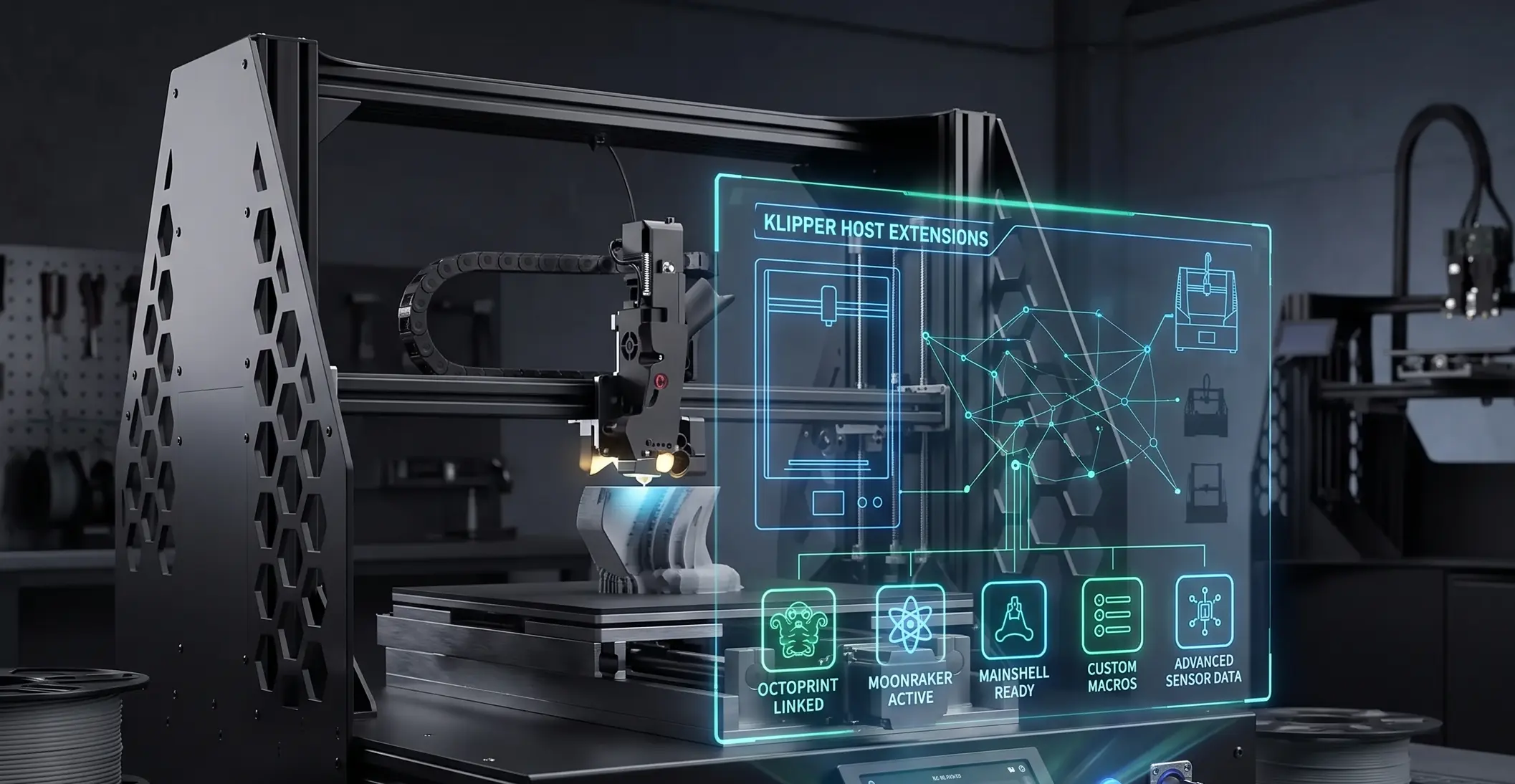
Klipper divides the work. A host computer takes over the compute-heavy motion planning, and the microcontroller only executes the pre-calculated steps. The host runs under Linux and the configuration sits in a text file.
What that means in operation
- Changes without recompiling. A change to the configuration is a text edit and a restart of the service – no flashing, no tools at the control cabinet.
- Compute power. What gets tight on a microcontroller is unproblematic on a host. That pays off as soon as sensors are added.
- Extensibility. Custom modules can be added on the host – what that looks like for us is in the article on Klipper extensions.
- One more computer. The drawback stated honestly: Klipper needs a host, and that is an extra device in the control cabinet that has to be powered and looked after.
Why this matters for pellet-based machines
A pellet extruder has more control loops than a filament head: several heating zones, material feed, output control. Added to that are sensors and, if wanted, camera-based monitoring. Each of those functions has to be connected and tuned – while the machine is running, not at the next firmware release.
That is exactly why we build on Klipper. The full reasoning is in why we build on Klipper at S2S; how a pellet extruder is put together is in the article on screw and heating zones.
The real question is not the firmware
Klipper or Marlin, what matters is whether you have access. A closed control system ties you to one manufacturer – for spare parts, for changes, and on the question of what happens if that manufacturer discontinues the product.
Our machines are open on this point: you connect your own sensors and adjust sequences yourself. There is more on this under 3D printer software built to measure and with the industrial 3D printers.