
Alumina and zirconia cover most of technical ceramics. There are requirements, though, that defeat both of them – very high temperatures combined with high strength, for instance, or thermal shock that makes an oxide crack. That is where the field of non-oxide ceramics begins, and two materials dominate it: silicon carbide (SiC) and silicon nitride (Si₃N₄).
We produce both on request. This article explains when that is worth it – and why these materials demand more of the process than the oxide ceramics do.
What makes non-oxide ceramics different
The name says it: alumina and zirconia are compounds containing oxygen. Chemically they are therefore already in their most stable state – they cannot oxidise any further. Silicon carbide and silicon nitride are not. That has two consequences.
In service: at high temperatures in air, a thin oxide layer forms on the surface. It often protects the part, but it is a limit that does not exist with oxide ceramics.
In production: sintering takes place not in air but under a protective atmosphere – with silicon nitride, typically under nitrogen. The furnace schedule is more involved than for Al₂O₃ or ZrO₂, and that shows up in cost and lead time.
Silicon carbide: hard, stiff, thermally conductive
SiC is one of the hardest materials available in engineering, which makes it a candidate wherever even alumina wears out.
- Extreme hardness and wear resistance against abrasive media.
- High thermal conductivity – unusual for a ceramic. SiC conducts heat away instead of letting it build up, and is therefore more resistant to thermal shock than the oxides.
- Very high stiffness at low density, which makes it interesting for moving and precision parts.
- Chemically resistant, including to aggressive media.
The limit: SiC is brittle. Like alumina it does not forgive impact and edge loading – it simply brings more hardness and temperature resistance with it.
Silicon nitride: tough and good at high temperature
Si₃N₄ is the material for parts that are hot, mechanically loaded and thermally cycled – a combination that is otherwise hard to serve.
- High strength and fracture toughness, including at elevated temperature. Among the high-temperature ceramics, Si₃N₄ is the most forgiving mechanically.
- Very good thermal shock resistance thanks to low thermal expansion. Temperature changes that would crack an oxide ceramic are usually survived by silicon nitride.
- Good tribological behaviour – which is why Si₃N₄ is used in rolling and sliding applications. Whether a pairing runs dry belongs in the design.
- Low density, considerably lighter than steel.
The limit: Si₃N₄ is among the most expensive technical ceramics, and the process chain is demanding. You choose it when the requirement forces it, not because it has the best numbers.
When is the effort worth it?
| Requirement | Material |
|---|---|
| maximum wear resistance against particles | Silicon carbide |
| heat has to be conducted away | Silicon carbide |
| rapid temperature changes under mechanical load | Silicon nitride |
| hot and highly loaded at the same time | Silicon nitride |
| dry running, sliding without lubrication | Silicon nitride |
| wear-resistant, but cost decides | alumina is usually enough |
| must not break, moderate temperature | zirconia is usually enough |
The last two rows are the most important part of the table. In most cases an oxide ceramic will carry the application, and then it is the more economical choice. How alumina and zirconia differ is set out in a separate article.
What pellet-based printing contributes
Non-oxide ceramics are known to be difficult to machine – which is precisely what makes them attractive as a material and expensive as a part. Every contour that has to be ground conventionally costs time on a machine running diamond tooling.
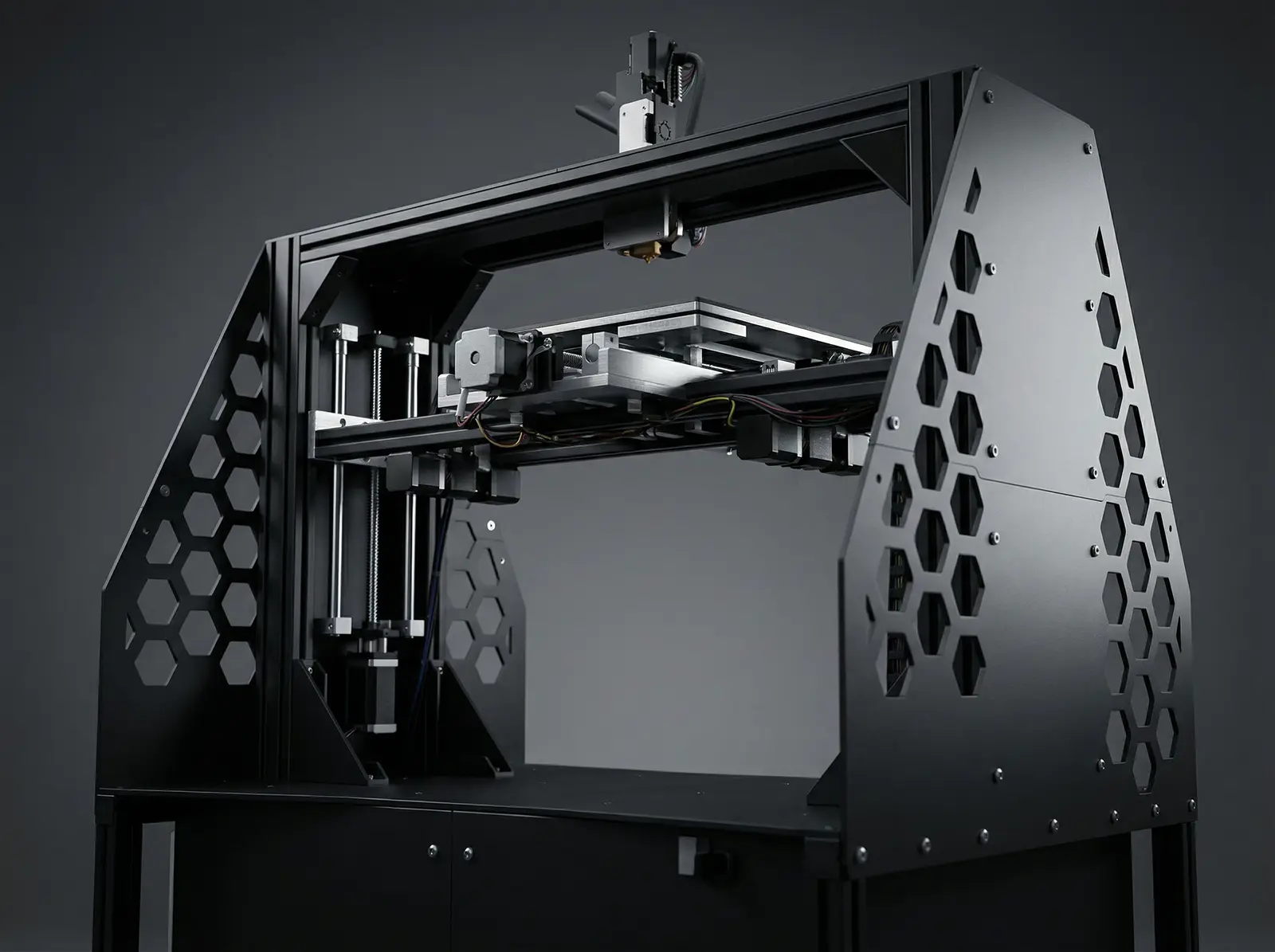
In polymer-bound pellet printing the contour is created before the material is hard. The green part can be machined, the sintered part can no longer be. That makes geometries economical that would not add up if they had to be ground – near-net-shape cavities, say, or structures no tool can reach. What is printable in a given case is something we settle on the geometry. The same principle we described for technical ceramics in general has its strongest effect with SiC and Si₃N₄.
The design rules remain those of ceramics: even wall thicknesses, at least 0.8 millimetres, solid sections above roughly 15 millimetres with a low infill. Shrinkage during sintering is no smaller with non-oxides, and the process windows are narrower.
How to enquire
SiC and Si₃N₄ are not catalogue items; every case has to be assessed individually. Tell us the part, the service temperature, the medium and the type of load, and we will tell you whether the material is necessary – or whether alumina will do the same job for less.
Binding figures are on the datasheet for the particular compound. General values from the literature help even less with non-oxide ceramics than with the oxides, because microstructure and sintering schedule have a strong influence on the properties.