
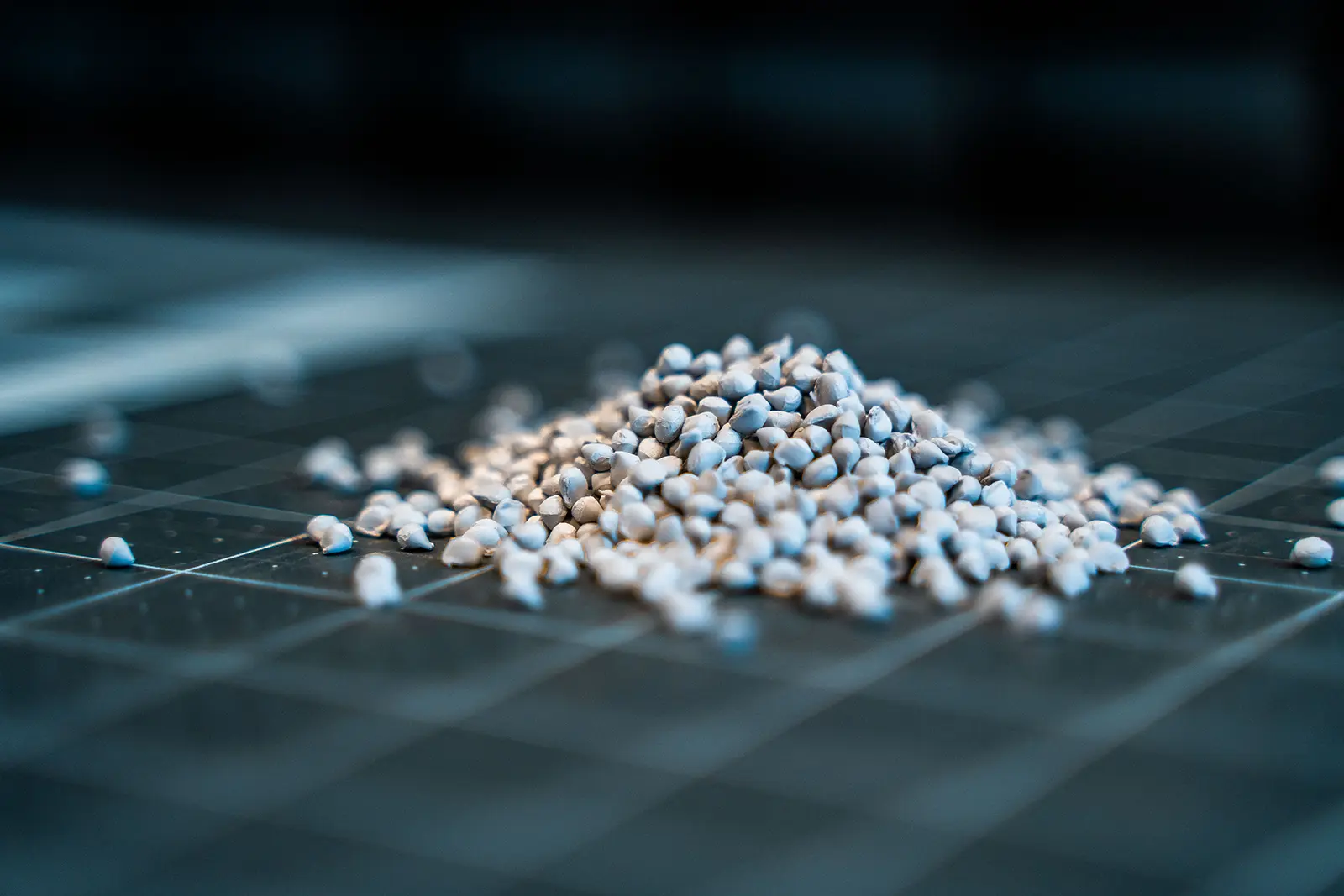
Anyone having a part made from technical ceramics faces much the same choice every time: alumina or zirconia. Both are oxide ceramics, both are processed as polymer-bound compounds in pellet-based printing, and both go through debinding and sintering. Yet in almost every property that matters they behave as opposites.
This article sorts the differences so that you can make the choice on your part rather than on a table. We deliberately quote no figures here: they depend on the particular compound, and they are binding only on the datasheet.
The one difference that explains the rest
Alumina (Al₂O₃) is hard and stiff. Zirconia (ZrO₂) is tough and resistant to fracture. In ceramics, hardness and toughness largely exclude one another, and almost everything else follows from that.
Hard materials resist wear but do not yield under load. Once a crack starts, it runs. Tough materials take more stress before they fail; with these two oxide ceramics, that comes with lower hardness and faster wear.
Zirconia owes its toughness to an effect that is unusual in ceramics: under stress the crystal lattice transforms locally and takes up slightly more space. That increase in volume presses against the crack tip and slows the crack down. The material helps itself – as long as it works within the right temperature window.
Alumina: the standard
Al₂O₃ is the most widely used technical ceramic, and for good reasons.
- Hard and wear-resistant. Wherever abrasive media, particles or friction act, alumina lasts longer than most alternatives.
- High service temperature. Al₂O₃ keeps its shape at temperatures at which many metals have long since started to creep.
- Electrically insulating. That makes it the standard for insulators, feedthroughs and carrier parts in electrical engineering.
- Chemically resistant and lower in cost. Of the two, alumina is the more economical material.
The weakness: Al₂O₃ is brittle. It does not forgive impact, edge loading or assembly stress. A part that is bolted, clamped or subject to shock loads is a risky choice in alumina.
Zirconia: when it must not break
ZrO₂ is the material for parts where fracture is the problem, not wear.
- High fracture toughness and flexural strength. Of the common oxide ceramics, zirconia takes the most mechanical load.
- Tolerates edge loading. Clamped joints and slender cross-sections are easier to realise in ZrO₂ than in Al₂O₃.
- Low thermal conductivity. Where heat should not flow away, that is an advantage – in thermal insulation, for example.
The weaknesses: zirconia is more expensive, softer than alumina, and not freely usable at high temperatures. The transformation effect that makes it tough works only within a limited window. Above that, ZrO₂ loses exactly the advantage it was chosen for. Moisture at moderate temperatures can also degrade certain grades over long periods – a point that belongs on the datasheet and in the design, not in a rule of thumb. For parts on or inside the body this is the decisive point; see ceramics in medical technology.
The decision in one table
| Your part … | Material | Why |
|---|---|---|
| runs against abrasive media | Alumina | for wear, hardness beats toughness |
| is bolted or clamped | Zirconia | tolerates edge pressure |
| works continuously at high temperature | Alumina | higher service temperature, no transformation window |
| has thin ribs or cutting edges | Zirconia | fracture toughness carries the geometry |
| insulates electrically | Alumina | established standard, lower cost |
| must not break if at all possible | Zirconia | the tougher of the two |
| should above all be inexpensive | Alumina | clearly more economical |
What pellet-based printing changes about the choice
In pellet-based printing a green part is produced first, larger than the final dimensions. Only debinding and sintering turn it into ceramic – and the part shrinks in the process. By how much depends on the compound. For your choice of material that means two things.
First: the design rules are the same for both materials. A minimum wall thickness of 0.8 millimetres, wall thicknesses as even as possible, and solid sections above roughly 15 millimetres built with a low infill. If the wall thickness jumps, the part shrinks unevenly and either distorts or cracks – regardless of whether the compound contains Al₂O₃ or ZrO₂. There is more on this in our article on the process chain from green part to sintered part.
Second: the green part can be machined, the sintered part effectively cannot. If you need a fit, put it into the green part – with the shrinkage allowance in mind. That applies to zirconia in particular, because it is precisely its toughness that makes machining the sintered part difficult.
What we print
We produce alumina and zirconia as polymer-bound compounds on the pellet extruder and carry out debinding and sintering in house; the debinding step is supported technically by ifw Jena. Silicon carbide and silicon nitride are available on request.
Density, hardness, flexural strength and maximum service temperature depend on the specific compound. Ask for the datasheet for your application rather than relying on general tabulated values – two Al₂O₃ compounds can differ noticeably in individual properties.
The fastest route to a decision
Do not tell us which material you want; tell us what the part has to withstand: temperature, medium, type of load, quantity. The material usually follows from that – and if both work, we will tell you which one is cheaper.