
Filament is processed pellets: melted, drawn into a strand, wound and packaged. Every one of those steps costs money and narrows the choice. Anyone who prints straight from pellets can reach for what the plastics industry supplies anyway – and that is considerably more.
The material groups at a glance
Standard materials such as PLA, PETG, ABS, ASA, PP and PE cover everything with no special requirements: fixtures, housings, models, packaging aids. They are inexpensive, readily available and straightforward to process.
Engineering plastics such as PA 6 and PA 12 come in when a part is mechanically loaded. Polycarbonate, when it has to be tough and transparent. Here it is no longer only a question of whether the material can be printed, but of how it behaves under load over time.
Fibre-reinforced compounds such as PPS-CF and PA-CF bring stiffness and temperature resistance that unfilled materials cannot reach. The price for that: these materials are abrasive and wear nozzles out quickly – which is why we use hardened or diamond-coated nozzles for them.
Elastomers such as TPU and TPE for anything that has to give – damping, seals, flexible zones. How far that can go is shown in the article on 3D printing on textiles.
How to identify the right pellets
- Service temperature. The first question, and the one on which most standard materials drop out.
- Mechanical load. Sustained load behaves differently from peak load; a material that holds briefly can creep under sustained load.
- Contact with media. Which media is the part exposed to, and for how long?
- Approvals. Food contact, medical, fire protection – here the datasheet decides, not experience.
The figures are on the datasheet for the material in question. Ask for it for your application rather than relying on general tabulated values – two PA 6 grades from different producers can differ noticeably.
Regrind and recyclate
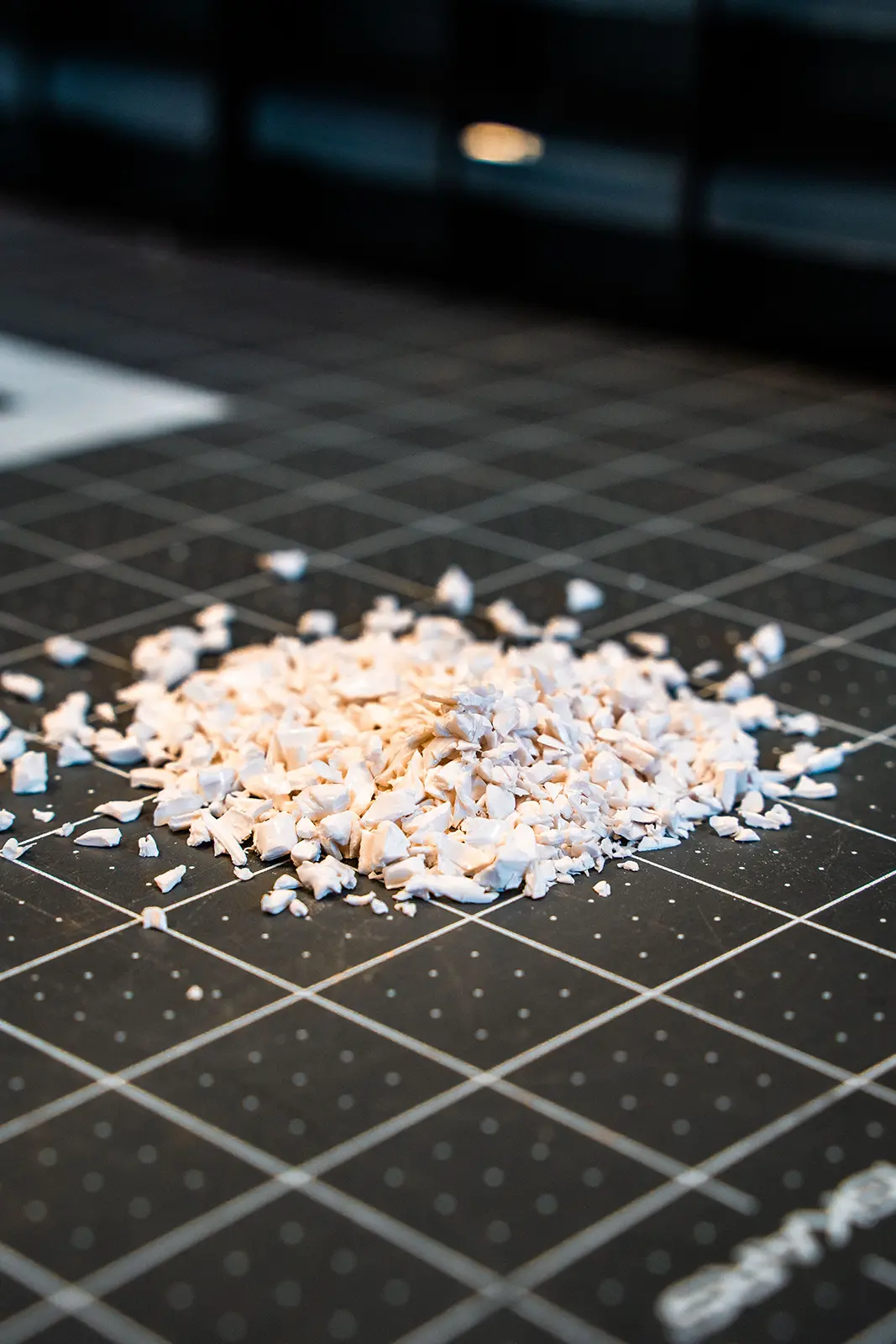
Pellets can be kept in a closed loop. Failed prints, support structures and sprues are ground up and fed back as a proportion, and recyclate from other sources likewise. How high that proportion may be depends on the material and the part – there is more on this in the article on regrind in 3D printing.
Where plastics reach their limit
When temperature, wear or chemistry are too much for the material, the route leads to technical ceramics. The same extrusion principle, a different material – and two additional process steps after printing.
A detailed treatment of the plastics is in the technical guide. Which materials we use in production can be found under plastics.