
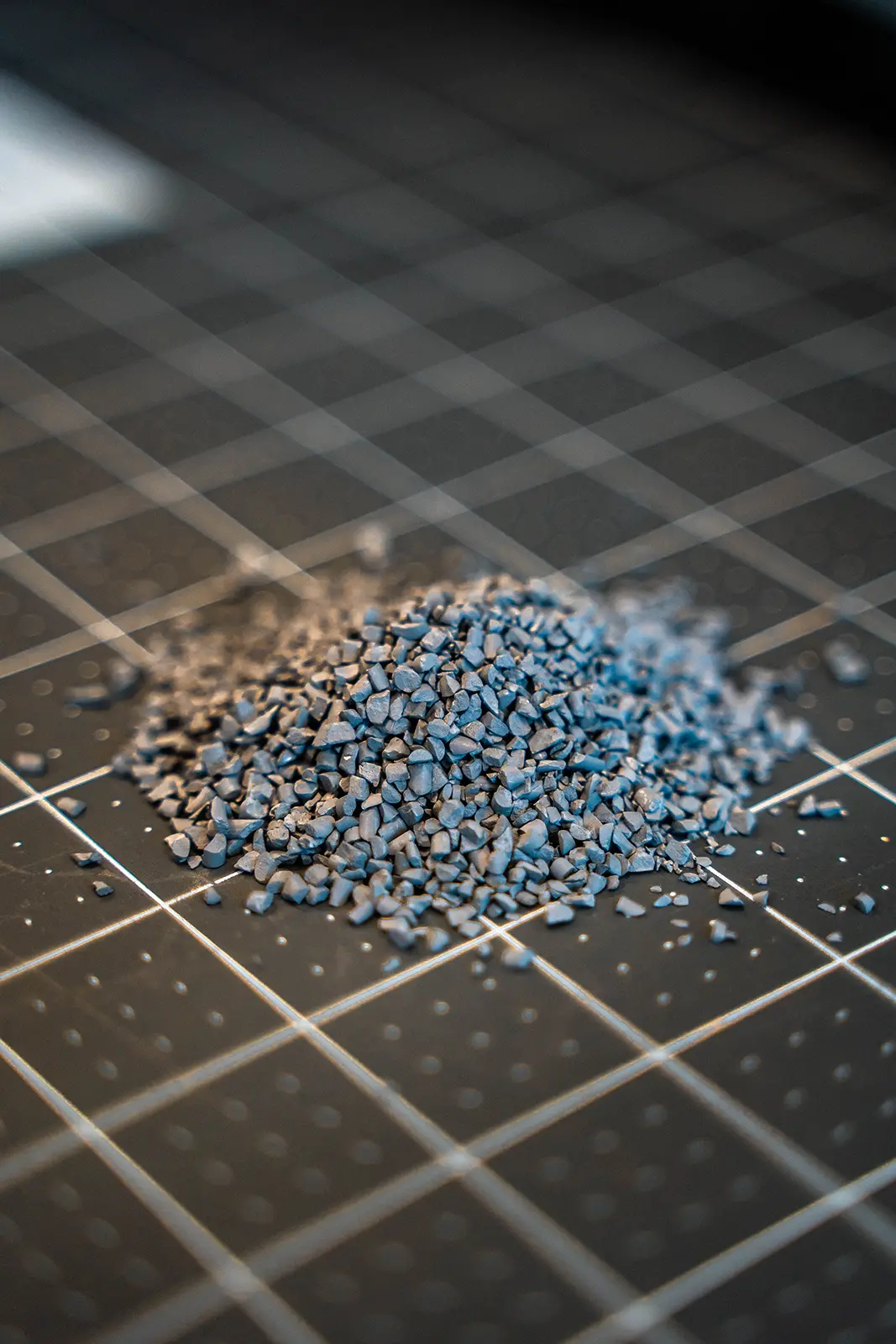
You meet both terms as soon as coloured, reinforced or functionally modified plastics come up, and each means something different. The distinction is not academic: it decides whether an additive can still be dosed in during the print.
Compound: mixed ready to use
A compound is a plastic in which the additive is already present at the concentration wanted. Colour, fibres, fillers – everything has been worked in at the producer and distributed evenly. You buy a set of pellets and process them, and that is that.
Advantage: reproducible and simple. Disadvantage: you need separate pellets for every formulation, and small quantities are expensive.
Masterbatch: a concentrate to blend in
A masterbatch is a highly concentrated carrier that is added to the base material only during processing – typically at a ratio of a few per cent. You keep base pellets in stock and vary the result through the masterbatch.
Advantage: one base material, many variants, small quantities affordable. Disadvantage: the blending has to come out evenly during processing – and that is exactly the point at which the printing process decides the outcome.
Why pellet printing has the advantage here
A filament printer processes a finished strand. Whatever is in it is in it; nothing can be blended in afterwards. If you want to change the formulation, you need a different filament.
Printing straight from pellets is different. An extruder screw conveys, melts and homogenises – it is essentially a small compounder. That makes it possible to feed an additive into the material stream while printing is under way. The technical basis for this is in the design of a pellet extruder.
What can be blended in live
- Colour changed without changing the base material.
- Blowing agent dosed in to create foamed, lighter sections.
- Fillers and fibres introduced where the part needs stiffness.
- Functional additives such as antibacterial agents, placed exactly where they are meant to act.
- Regrind and recyclate fed back as a proportion rather than processed separately.
The real gain: gradients
Because the blend can be changed during the print, a part does not have to be the same material throughout. A sole that is hard at the top and becomes soft towards the contact face is then one part instead of an assembly of two – no two-shot tool, no assembly, no bonded joint that could fail.
In orthopaedic technology that is the practical benefit; what it looks like is shown in the article on additive manufacturing in orthopaedic technology. What our machines can do here is under blending compounds and additives live.