
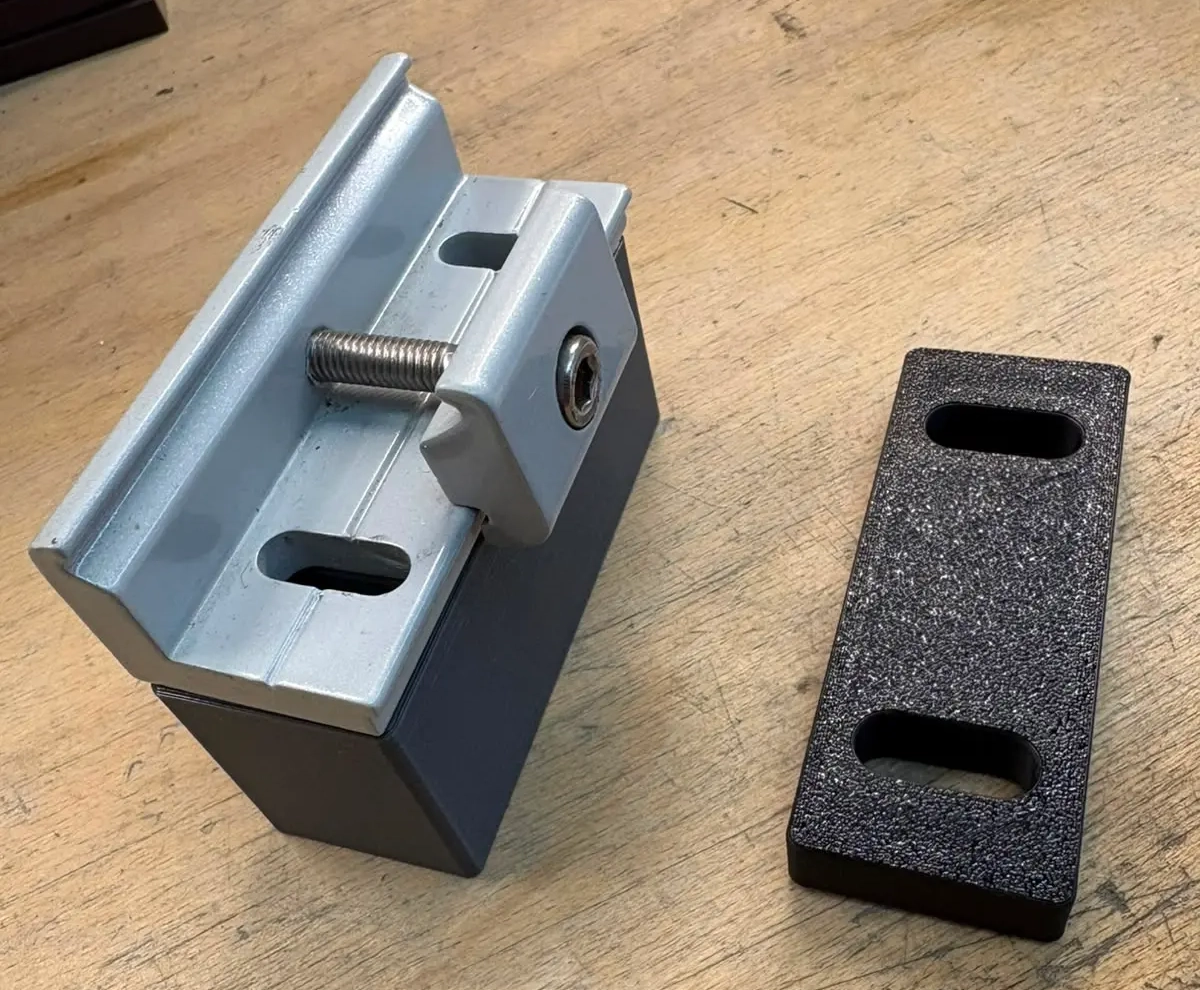
In machinery, the most expensive parts are rarely the expensive ones. They are the small ones nobody keeps in stock: a guide roller, a bracket, a cover that came with the machine twelve years ago and was discontinued by the manufacturer long since. The machine is down, and the lead time is the problem – not the price.
Why printed spare parts fit here
Three characteristics of additive manufacturing match this case exactly. There is no minimum quantity: one piece is possible. There is no tooling, so there are no fixed costs that would have to be spread over a quantity. And there is no stockholding: the geometry exists as a file, and the part is made when it is needed.
Compared with machining, there is the added point that complex geometry costs nothing. A bracket with an organically optimised shape is no more expensive to print than a cuboid.
When printing is the right answer
- The original part is no longer available or has an unacceptable lead time.
- The part is plastic, or can be made in plastic.
- The quantity is small – one part, five parts, a set for the next few years.
- The geometry is known, or can be derived from the original part.
When it is not
Honesty is part of this: safety-relevant parts, highly loaded metal parts and anything whose approval attaches to the original part are not candidates. Where a part has a load-bearing function, its strength has to be demonstrated – and that evidence is often more work than procuring the original.
Choosing the material: copy the function, not the original
The original part was made from a particular plastic because it was injection-moulded. A printed one-off works under different constraints. What matters is what the part has to withstand: temperature, load, media. The material follows from that – there is more on this under plastic pellets in 3D printing.
Where wear or temperature are too much for plastics, technical ceramics come into consideration – for insulators, say, or parts in furnace equipment.
From the broken part to a file
It is easiest when a CAD file exists. If not, a simple geometry can often be derived from the original part – measure, draw, print. We accept STL and STEP; we will sign a non-disclosure agreement beforehand on request.
You can get a first indicative price through the calculator, and everything else through 3D printing contract manufacturing. What parts like these look like in practice is shown in the practical example on simple parts.