
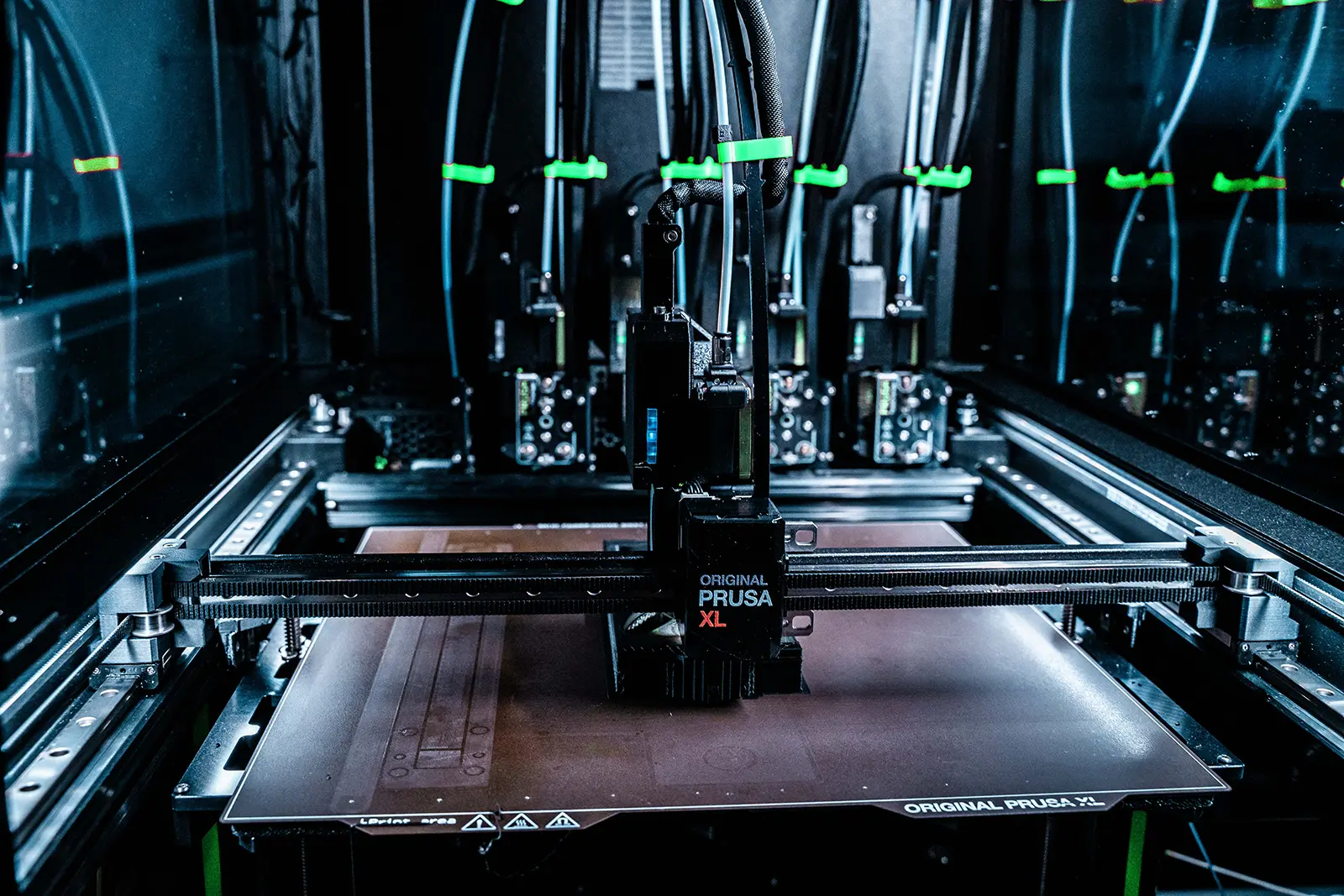
“3D printing” is an umbrella term for processes that have little in common beyond building up in layers. Anyone having a part made therefore faces a decision that affects cost, strength and surface more than any choice of material does. This article sets out the three processes we use in 3D printing contract manufacturing.
FFF: filament, the familiar route
Fused filament fabrication, often also called FDM, processes a ready-made plastic strand. It is fed in, melted and deposited. The process is mature, the choice of materials is wide and the equipment is inexpensive.
Our build volume here is 360 × 360 × 360 millimetres, with an achievable tolerance of around ± 0.1 millimetres. Typical applications: functional parts, fixtures, housings, engineering plastics.
FGF: straight from the pellets
Fused granular fabrication skips the detour via filament and processes pellets – the same ones the plastics industry supplies for injection moulding. An extruder screw conveys, melts and homogenises the material.
That has three consequences. The material costs a fraction, because the processing step into filament is not needed. The output rate is many times higher, up to 500 grams per hour with plastics. And the choice of materials is not limited to whatever someone offers as filament – regrind and in-house compounds can be processed too.
Our build volume: 300 × 300 × 300 millimetres, tolerance likewise around ± 0.1 millimetres. The detailed comparison is in filament extruder vs. pellet extruder.
SLA: when detail matters
Stereolithography cures liquid resin layer by layer with light. The result is smooth surfaces and fine structures that extrusion-based processes cannot reach. The tolerance is around ± 0.02 millimetres – an order of magnitude better than FFF and FGF.
We produce SLA parts through a partner, with build volumes of 700 × 700 × 200 and 450 × 450 × 350 millimetres. The price for that: different material properties, limited temperature resistance and a longer lead time, because the part is made externally.
Ceramics: one process with two downstream steps
Polymer-bound ceramics run technically like FGF, but have two further steps afterwards: debinding and sintering. That makes the process chain longer and the design rules stricter, but it opens up materials that none of the other processes can deliver. Details under technical ceramics in 3D printing.
Side by side
| Process | Build volume | Tolerance | Production | Strength |
|---|---|---|---|---|
| FFF | 360 × 360 × 360 mm | ± 0.1 mm | in house | wide choice of materials |
| FGF | 300 × 300 × 300 mm | ± 0.1 mm | in house | production materials, throughput, regrind |
| Ceramics | 300 × 300 × 300 mm | ± 0.1 mm on the green part | in house | hardness, temperature, chemistry |
| SLA | 700 × 700 × 200 mm | ± 0.02 mm | partner | detail and surface |
How to decide
Three questions usually get you there. Should the part behave like the later production part? Then FGF with the production material. Does it need fine detail or a smooth surface? Then SLA. Does it have to withstand temperature, wear or chemicals at which plastics fail? Then ceramics.
If you are further back than that and want to get clear first on what a prototype is actually meant to deliver, rapid prototyping explained will help.
Which tolerance is actually achievable on your part is something we say after the technical review – the tabulated values apply to well-designed parts, not to every geometry. There is more on this under tolerances and surface finish.